Articles

Short essays on the mechanics.

How the subconscious actually operates — and why so much sincere effort bounces off it. Concepts drawn from the Inner Influencing® framework created by Paul Greblick, written up here by the practice.

Possibility
If one person has done it, it’s the standard
Beliefs
Karma, or a thermostat?
Emotions
Shame is a multiplication problem
Emotions
Guilt doesn’t need a witness
Attraction
Why manifesting stalls
Mechanics
Your feelings are printouts
Relationships
The same person, wearing a different face
Self-blame
You can’t give yourself a virus
Anxiety
Anxiety is a false premonition
Receiving
Why good things make you nervous
Plant Medicine
What ayahuasca actually fixes — by the numbers
Plant Medicine
The shaman, the molecule, and the missing operator
Plant Medicine
The elders came down: fifty years of evidence from the masters themselves
Plant Medicine
Grof’s patients really did heal. Look closer at how.
Mechanics
Every method that works is doing the same thing — slowly
Depth Psychology
Making the unconscious conscious — then what?
Depth Psychology
The pain that arrived before you did
The Field
The notes everyone can read but you
The Field
Same coordinates, different universe
Case File
The ceiling that was never about money
Inheritance
You didn’t learn it from them. You absorbed it.
The Body
Why the plan works for three weeks
Lineage
The physicist who edited his own code
Lineage
Karma, manifesting, and the Self: Lester’s fine print
Attraction
Everything is already manifesting. That’s the problem.
Possibility
Impossible, unlikely, probable, certain, normal: the five rungs
Releasing
Why releasing made you calm and didn’t change your life
Releasing
The resistance was never in the way. It was the file.
Releasing
How to tell a release from a rest
Possibility

If one person has done it, it’s the standard

For years, the four-minute mile was considered physiologically impossible. Doctors wrote papers about it. Then in 1954 Roger Bannister ran 3:59.4 — and within a year, other runners had done it too. Within a decade it was routine for elite milers. Human legs didn’t change. The reference point did.

Your subconscious works exactly like those runners. It doesn’t evaluate what’s possible by physics — it evaluates by precedent.

If it has a file that says “people like me don’t get that,” then that’s the operating truth, and no amount of wanting overrides an operating truth.

This is why the same person can grind for a decade and stay at the same level: the effort was real, but the ceiling was filed as fact.

Here’s the mechanical insight: the ceiling is a missing reference point, not a measurement of you.

Somebody, somewhere, has the thing you want at the level you want it — the income arriving easily, the relationship that’s calm and alive at the same time, the health that doesn’t require managing. That person isn’t an anomaly. They’re a Bannister.

They are proof of what the human system permits — which means they’re proof of what your system permits, once the file gets updated.

And when you look for an example and genuinely can’t find one — someone from your background, your circumstances, your starting line — the conclusion isn’t “so it can’t be done.” You simply haven’t been exposed to all the examples.

And if the example really doesn’t exist yet: be the first one. There’s no quota. Nobody ran out of four-minute miles. The first person through just makes it ordinary for everyone behind them.

If you want the strangest Bannister on record, take Lester Levenson: 1952, sent home with weeks to live, told any exertion could kill him — and he lived another forty-two years in a state of ease most people never touch.

Whatever your file says about what’s recoverable, what’s too late, what people with your history get — one man’s three months in a Manhattan apartment outvotes it.

Why does precedent carry this much force? Because the subconscious is a survival machine, and survival machines don’t gamble — they permit what’s been demonstrated. No file, no permission.

This is also why testimony moves people when argument can’t: an argument asks the system to reason, and reasoning isn’t its language. An existence proof speaks precedent — the one dialect it trusts.

And there’s a floor under all of it worth knowing about. Lester’s strangest discovery wasn’t that the ceiling could be raised — it’s that the ceiling is expensive: “It takes effort to be limited when your natural state is unlimited.”

Read that against the four-minute mile. The limit was never load-bearing. It was being actively held in place — by the very system that complained about it. Possibility isn’t the achievement. It’s the default, minus the file.

The standard-effect concept is from the Inner Influencing® framework, created by Paul Greblick — innerinfluencing.com.

Beliefs

Karma, or a thermostat?

When the same kind of thing keeps happening to you — the same betrayal with a different face, the same collapse right before the breakthrough, the same money arriving and evaporating — there are two available explanations.

One is cosmic: it’s karma, a ledger, lessons you were assigned and must complete before life will let you through. The other is mechanical. It’s worth noticing which one leaves you with something to do.

The karma frame has a quiet cost that its gentleness hides: it puts the lock outside of you. If your difficulty is a debt from somewhere else or a curriculum you were enrolled in without consent, then there’s nothing to fix — only sentences to serve.

And there’s a simple question that strains the whole theory: look at someone whose life has been easier than yours. Are they wiser? Did they study harder? Are they a better student of the universe? If lighter lives don’t mean lighter people, then “lessons” isn’t the mechanism.

Here’s the mechanical explanation. Your subconscious maintains a set point — a level of income, intimacy, ease, and safety that it recognizes as yours. Like a thermostat, it doesn’t judge the setting; it enforces it.

Drift above it and the system engineers a return: the sabotaged opportunity, the manufactured fight, the windfall absorbed by a convenient emergency. Drift below and it pulls you back up. From inside, this feels exactly like fate. Same shape, same timing, same uncanny precision. It isn’t a ledger. It’s a setting.

The difference between the two explanations is everything, because settings can be changed and sentences can only be served. Nothing here requires disrespect to anyone’s tradition — only a practical test: change the setting, and watch whether your “karma” changes with it. In our experience, it does not survive the update.

It’s worth hearing how the most realized voice in this site’s lineage defined the word. Lester Levenson took karma seriously — and stripped it to mechanics: “Karma is the law of compensation. Everything you give out comes back to you.”

Then he located where the giving-out happens: “Every little thing that happens to each and every one of us is created in our thinking.”

Put those together and karma stops being a court and becomes a circuit. What you “give out” isn’t your deeds — it’s your broadcast: the standing code, transmitting day and night. What “comes back” is the rendering. The law is real. The ledger was never the mechanism. The loop was.

And notice what a loop permits that a ledger forbids: intervention at the source. Lester held the fullest version of the doctrine — charge carried forward, lifetimes deep — and still treated every bit of it as editable, because created-in-thinking means changeable-in-thinking.

Even the man who believed karma reached back farthest treated it as a setting, not a sentence.

The set-point and repulsion concepts are from the Inner Influencing® framework, created by Paul Greblick — innerinfluencing.com.

Emotions

Shame is a multiplication problem

Shame feels like a fact about you. It behaves like arithmetic. The weight of any shameful memory is the product of exactly two factors: how you feel about yourself in it, multiplied by your certainty that other people remember and care. Two factors. And anything multiplied by zero is zero.

Most approaches to shame attack neither factor. They manage the product — breathe through it, reframe it, share it in a safe circle — and the relief is real and temporary, because both factors are still loaded and still multiplying. The math reruns every time the memory does.

Take the second factor first, because it’s the one propped up by an assumption that is almost always false. Your system is convinced that the embarrassing thing lives as vividly in everyone else’s memory as it does in yours.

Run the honest audit: the people who witnessed it were mostly thinking about themselves that day, forgot it within the week, and have thought about it roughly never since. You are, in nearly every case, the only person still holding the file open. Shame is the subconscious over-assuming an audience that went home years ago.

One more thing shame does that masquerades as virtue: it generates a compulsion to disclose — the feeling that people must know certain things about your past before you’re allowed to fully show up.

That isn’t honesty; honesty doesn’t require volunteering your worst chapters to anyone who might matter. It’s the second factor demanding tribute.

When the charge underneath is actually cleared, you can still tell anyone anything — the difference is that nothing forces you to.

Now go one level deeper, because shame has an engine room.

Sort any shameful memory through the three motivators and it lands in the same slot every time: shame is the approval want, inverted — not the hope of being approved of, but the standing certainty of what would happen if they really knew. Same want. Reversed sign.

Which means shame isn’t its own species of pain that needs its own cure — it’s a lack of approval, filed as a verdict, and verdicts are exactly what edits are for.

And here is what shame does that no other emotion does as well: it manufactures unconscious material. Lester’s definition — “the unconscious mind is only that part of the mind that we refuse to look at” — describes shame’s exact job.

Shame is the refusal engine. Every memory it makes unlookable-at gets filed below the read line with its charge intact, where it runs unopposed.

The hiding then compounds. A system that hides something concludes, from its own hiding, that the something must be shameful — evidence it wrote itself. Interest on a loan you never took out.

So the multiplication has one more factor worth naming: the first one — how you feel about yourself in the memory — is not a perception. It’s a conclusion, drawn once, usually by someone very young, and never re-tried. Conclusions can be un-concluded. That’s the factor the edit zeroes — and anything multiplied by zero is zero.

The shame-as-emotional-math and related concepts are from the Inner Influencing® framework, created by Paul Greblick — innerinfluencing.com.

Emotions

Guilt doesn’t need a witness

The standard prescription for guilt is confession: tell someone, be witnessed, be absolved. And confession does produce relief — briefly. Then the weight comes back, and has to be confessed again. That cycle isn’t a failure of sincerity. It’s a clue about the mechanism.

Notice what actually happens when another person “takes” your guilt: nothing changes hands. There is no substance they extract, nothing tangible that leaves you and enters them. What their acceptance does is temporarily lower your own prohibition against feeling okay.

The guilt was never in their power to remove — which is why the relief runs out and the confessing has to be repeated. Anything that must be re-administered is managing a charge, not clearing one.

There’s a second structure hiding inside guilt: the open loop. Some part of you is waiting — for the apology you owe to be accepted, for the person you wronged to declare it settled, for a verdict only someone else can deliver.

Handing the loop’s closure to another person means their reaction now runs your inner state, indefinitely. Sometimes they’re not even alive to close it.

The loop can be closed from your side — not by pretending nothing happened, but by clearing the charge that keeps demanding a verdict.

None of this argues against making real amends. If someone is genuinely owed something — repair, restitution, the truth — that debt survives any amount of inner work, and paying it is simply right. The test is honest and clean: if telling them serves them, it survives the clearing.

If telling them serves the ache, the ache was the target. Clear first. Then decide. A decision made from a cleared system is the only one that was ever actually free.

There’s one more mechanism running under guilt, and naming it changes how the whole emotion reads: guilt is an attempt to pay a debt with pain. Somewhere the system concluded that feeling bad enough, long enough, constitutes restitution — that suffering is a currency the wronged party somehow receives.

Run the audit: no amount of your feeling terrible has ever transferred one unit of value to the person you wronged. The payments leave your account and arrive nowhere. Amends transfer value. Suffering just burns it.

And when Lester Levenson cleared his own past — the failed loves, the harm done in his old life — notice the operation he used, because it wasn’t punishment and it wasn’t confession.

He re-examined the record: “Where I thought I had been loving, I saw I wanted to be loved.” The guilt-soaked moments turned out to be moments of a person acting from lack — and seeing that, he corrected the conclusion, not the sentence-length.

That’s the model. The behavior came from a want running you at the time; the want was installed, not chosen; the verdict can be dropped while the lesson stays. What survives the clearing is exactly what should: the wisdom, the amends genuinely owed — and not one day more of the sentence.

Concepts drawn from the Inner Influencing® framework, created by Paul Greblick — innerinfluencing.com. Lester Levenson’s review method per his autobiography, No Attachments, No Aversions.

Attraction

Why manifesting stalls

Everyone who has tried manifesting knows the pattern: the vision board, the scripting, the affirmations — a burst of momentum, a few promising signs, and then the quiet return to exactly where you started.

The standard explanations are that you didn’t believe hard enough or visualize clearly enough. There’s a more mechanical explanation, and it’s kinder: you were pulling with one hand and pushing with both.

Attraction and repulsion aren’t two different forces — they’re one mechanism running in whichever direction your deeper programming points it.

If the subconscious holds “good things don’t last,” “more money means more danger,” “people like me don’t get this” — then it isn’t merely failing to attract.

It is actively keeping the thing away, because it has calculated that receiving it is unsafe. No visualization out-votes a safety system.

This is why affirmations bounce. Saying “I am abundant” over an uncleared “abundance is dangerous” isn’t a rewrite — it’s a wish, filed against a verdict, and the verdict has seniority.

Worse, trying harder amplifies the problem: desperation is fear wearing desire’s clothes, and fear broadcasts keep it away. The harder you chase, the harder the system defends.

And even when forcing works briefly, there’s a reason it doesn’t hold: a wished-for thing sits on top of the old setting, and the old setting wins the long game.

The lottery-winner statistics are the famous version — money arriving far above the identity that received it, expelled within a few years. The order of operations was never attract, then feel safe having it.

It’s the reverse: clear what the system is defending against, and receiving stops being a threat. You don’t have to learn to attract. You have to stop repelling — and the difference between those two projects is the difference between pushing a river and unblocking one.

The deepest version of this was written by the man the modern manifesting world descends from and mostly hasn’t read. Lester Levenson said the sentence everyone quotes — “What you hold in mind, you create” — and then the fine print almost everyone skips: “Lack creates desire. Desire therefore cannot undo the lack.”

Sit with the geometry of that. Wanting is not holding the thing in mind. Wanting is holding the absence of the thing in mind — the lack, open and running, broadcast around the clock. The vision board is an hour of picture; the want underneath is twenty-four hours of missing. Guess which one the system builds.

Which is why his conclusion sounds backwards and tests true: “Not wanting equates to having.” Look at the things that flow to you effortlessly — they’re precisely the ones you have no charge on. You never “manifested” them. Nothing was in the way.

And his last word on it relocates the entire project: “Our Beingness is always trying to create our goals, and we get in the way with wanting approval, wanting control, and wanting security.” The engine was never off.

Nothing needs to be summoned, attracted, or vibrated into range. Something needs to be removed from the doorway — and it has an address.

The Law of Repulsion and related concepts are from the Inner Influencing® framework, created by Paul Greblick — innerinfluencing.com.

Mechanics

Your feelings are printouts

The universal assumption about emotions is that they’re reactions: something happens, and you feel accordingly. It seems self-evident. It’s also backwards — and getting this one thing right changes how you relate to every feeling you’ll ever have.

Two people get laid off from the same company on the same afternoon. One is devastated; the other feels, to their own surprise, free. Identical event — opposite emotions. If feelings were reactions to events, that couldn’t happen.

What actually occurred: each person’s subconscious ran the event through its own stored files — every precedent about money, worth, safety, failure — and delivered a conclusion. The feeling is the printout of processing that already finished. By the time you feel it, the verdict is in.

This is why “managing your emotions” is such exhausting, endless work: you’re managing output. It’s the smoke alarm, not the fire. You can learn to breathe through the alarm, reframe the alarm, sit with the alarm — and the program that keeps triggering it prints another copy tomorrow, because nothing touched the file it prints from.

One clarification that matters: your feelings are never lying. They are perfectly accurate reports — about what’s in your subconscious. They are frequently terrible reports about reality.

The dread you feel before the meeting is true data about a stored file; it may be zero data about the meeting.

Learning to read feelings that way — as printouts pointing at files, rather than facts about the world — is the difference between being run by the output and using it as a map to what needs clearing.

Once you read them that way, a sorting trick makes the map fast. Every negative printout traces back to one of three threatened wants — approval, control, or security — the three drives Lester Levenson found under the mind’s entire output.

Anger is almost always control, denied. Hurt is approval, withdrawn. Worry is security, threatened. Ask “which of the three just got stepped on?” and the feeling stops being weather and becomes a file location.

This also flips the status of your worst moments. A trigger is the diagnostic working perfectly: some situation just found a live file and printed its contents, free of charge.

The day’s most upsetting moment is the day’s most precise intelligence about what’s still stored — which is why the practice here treats strong reactions as targeting data, not failures.

And the endpoint of all this reading is worth stating, because Lester embodied it: a printout with no charge behind it prints nothing. “Unlimited happiness is our very basic nature… before we encumber it with limitations.” The goal was never to manage the output better. It’s an archive with nothing left in it that prints pain.

Concepts drawn from the Inner Influencing® framework, created by Paul Greblick — innerinfluencing.com.

Relationships

The same person, wearing a different face

Look back at the people who’ve hurt you — the partners, the bosses, the friends who turned. Different names, different cities, different everything. Now look at how each one ended. If you’re honest, there’s usually one script, performed by a rotating cast. That isn’t bad taste in people, and it isn’t bad luck. It’s casting.

The subconscious holds a template — built from the earliest people who had power over you — of what closeness is, what it costs, and how it goes wrong. Then it does two things with remarkable efficiency.

It recognizes template-matches instantly and generates chemistry for them: the “spark” is often your oldest file lighting up in recognition.

And it trains whoever’s cast: the flinches you show, what you tolerate, what you apologize for — people read it and, without either of you deciding anything, the old dynamic reassembles itself.

This is also why the same words hit differently from different people. A stranger criticizes you and it bounces; someone wearing the right labels — partner, parent, boss — says the identical sentence and you’re wrecked for a week. The words were never the payload.

The label is a container of stored charge, and the closer the person matches the original template, the bigger the container they’re holding.

The exit isn’t better vetting. You can’t out-screen a casting director who works below your awareness and controls who feels like chemistry.

The exit is retiring the template — clearing the original file — after which two things reliably happen: the people who used to feel magnetic start reading as information, and kindness stops feeling boring. What felt like “your type” turns out to have been your wound, with a lighting budget.

There’s a deeper cut here, and it belongs to Lester Levenson. Dying in 1952, he audited every relationship he’d ever had and found the same discovery waiting in each one: “Where I thought I had been loving, I saw I wanted to be loved.”

What he had called love was, on inspection, the approval want wearing love’s clothes — a lack, out shopping.

That’s what the template actually is. The casting director isn’t looking for a partner; it’s looking for a supplier — someone shaped like the original person whose approval was life-or-death, because the file says that’s where the missing thing is kept. Chemistry is the recognition ping. The ache afterward is the lack, unfilled again, exactly as filed.

Which explains the cruelest feature of wound-driven attraction: it cannot be satisfied. A supplier who actually gives the approval doesn’t close the file — the file isn’t a hole that fills; it’s a conclusion that renders.

Hence the pattern where being genuinely loved feels wrong, boring, suspicious: the system wasn’t seeking love. It was seeking the familiar shape of its absence.

Lester’s exit and this practice’s exit are the same move at different speeds: dissolve the lack itself. When the wanting-to-be-loved clears, what remains is what he found — happiness that equates to loving, not to being loved. The template doesn’t need better casting after that. The production closes.

Concepts drawn from the Inner Influencing® framework, created by Paul Greblick — innerinfluencing.com.

Self-blame

You can’t give yourself a virus

Here’s a question for everyone who’s ever hated themselves for a pattern — the procrastination, the temper, the habit you’ve quit forty times: would you ever have chosen to install it? Sit with that. Nobody picks self-sabotage off a menu.

Nobody volunteers for a fear of being seen. A computer can’t give itself a virus — something has to put it there. Yours came from somewhere, early, before you had any say — and every day since, you’ve been blaming the computer for the code.

The self-blame rests on a simple category error about how the mind is built. Your conscious mind holds the wisdom: it knows what’s good for you, sets the goals, makes the promises. Your subconscious holds the power: it processes millions of bits to your fifty and executes its programming regardless of your opinions about it. And power overrides wisdom. Every time.

The smoker who “knows better,” the chronic starter-over, the person who watches themselves do the thing they swore off — none of them lack character. They’re losing a rigged fight and being told it’s a moral failure.

Want proof the pattern isn’t yours? You’re fighting it. If it were truly yours — chosen, endorsed, you — you’d be defending it, not exhausting yourself against it for decades. The struggle itself is the evidence of the split: the part of you that’s reading this never agreed to the program it’s been held responsible for.

None of this is a pass to stay stuck — it’s a reassignment of the job. You didn’t write the code, so the verdict gets dropped. It runs on your machine, so the cleanup is yours. Not your fault; still your move. And the move was never more willpower — it’s changing what the power is running.

Lester Levenson said the exonerating part in one line: “We go on and on repeating all this behavior of limitation automatically, calling it subconscious.” Automatically. The pattern isn’t a decision you keep making badly — it’s a recording you keep being run by. Nobody prosecutes a tape for its contents.

Then he said the strangest part, the one that turns the whole self-blame story inside out: “It takes effort to be limited when your natural state is unlimited.” You are not failing to hold yourself together.

You are succeeding, all day, at holding the program up — and calling the exhaustion a character flaw. The tiredness isn’t evidence of weakness. It’s the electric bill of the code.

And one more reason to drop the courtroom: prosecution adds charge. Every round of self-contempt about the pattern files new material about the pattern — shame on top of sabotage, verdicts about verdicts. You can’t punish a file into closing; you can only fatten it.

The good news is mechanical, and Lester tested it on himself: the system ships with an uninstaller. “The moment you let go of them, they are gone!” Deletion is a native function — it just has to be run at the layer that holds the file, instead of the courtroom that’s been trying the case.

Concepts drawn from the Inner Influencing® framework, created by Paul Greblick — innerinfluencing.com.

Anxiety

Anxiety is a false premonition

Anxiety presents itself as foresight. It feels like information about the future — a preview of the meeting going wrong, the text meaning what you fear, the other shoe mid-drop. That’s the disguise.

Look closer at any anxious projection and you’ll find it’s built entirely from used parts: it’s memory, pointed forward. The subconscious takes its worst stored files, renders them onto next Tuesday, and labels the result a forecast.

Which explains anxiety’s otherwise strange properties. Why it ignores base rates — the feared thing almost never happens, and the track record never updates the forecast.

Why it’s so specific to you — your anxiety runs your childhood’s greatest hits, not generic dangers. And why reassurance bounces off it: you can’t fact-check a memory by arguing about the future. The projection isn’t about Tuesday. Tuesday is just the screen it’s playing on.

There’s a second engine underneath, and it’s sneakier: the undecided state. Stand at a fork refusing to choose — stay or leave, send it or don’t, say it or swallow it — and anxiety hums indefinitely.

Notice what happens the moment you genuinely decide, either direction: the anxiety drops before you know if you chose right. It was never about the outcome. It was the cost of standing at the fork — a cost many people pay for years at a time on their biggest questions.

The practical reframe: treat a future worry exactly like a bad memory, because mechanically that’s what it is — the same stored charge, projected instead of recalled. You don’t manage a false premonition, and you can’t out-argue one. You clear the file it’s printed from — and the forecast changes because the archive did.

Two additions sharpen the picture. First, sort any anxiety through the three wants — approval, control, security — and it always resolves: the presentation-dread is approval, forecast to fail; the health spiral is security; the loved-one worry is control, projected onto what can’t be controlled. Naming the threatened want turns a fog into an address.

Second, understand why the undecided fork hums. A system that renders futures doesn’t wait for you to choose — it renders both branches, simultaneously, on a loop. Stand at the fork and you’re paying double rendering costs around the clock.

Deciding doesn’t fix the future; it shuts down one of the renders. That’s why the relief arrives before any outcome does.

And the endpoint is worth naming, because it’s not “better anxiety management.” A cleared archive renders Tuesday from what Tuesday actually is.

Sometimes that render includes an accurate signal — real preparation needed, a real risk worth handling — and you’ll recognize the difference immediately: accurate signals arrive once, point at an action, and leave. Only false premonitions loop.

Concepts drawn from the Inner Influencing® framework, created by Paul Greblick — innerinfluencing.com.

Receiving

Why good things make you nervous

Notice what happens in your body when something works out too easily. The job that lands without a grind. The person who just… likes you, no chase. The month where nothing goes wrong.

For most people the honest answer is suspicion — a low hum of what’s the catch, an urge to double-check something. We treat this as prudence. It’s worth asking what kind of prudence gets nervous specifically about good news.

Here’s the mechanism. The subconscious files “safe” as “whatever you’ve already survived.” Your familiar level of money, love, and ease — however uncomfortable — is certified survivable.

An upgrade is uncertified territory, and to a survival system, uncertified means dangerous. So good things arriving fast don’t register as fortune; they register as exposure.

And a system that reads gifts as exposure will quietly handle them: the raise followed by inexplicable dread, the great relationship you pick apart until it fits your ceiling, the windfall that a convenient emergency absorbs down to the familiar number.

This is the unglamorous truth about most self-sabotage: it isn’t a death wish — it’s a return policy.

Everyone lives at the highest level of good they can currently hold without bracing — and everything above that line gets traded back for the feeling of safety, usually disguised as “being realistic,” “bad timing,” or “it just didn’t work out.”

So the work isn’t learning to want more. You already want it; wanting was never the bottleneck. The work is making the upgrade certified — clearing the files that equate better with dangerous — so that when the good thing arrives, nothing in you needs to send it back. The test of progress is precise: good news lands, and your body does nothing at all.

And here is the reframe underneath the whole article, courtesy of Lester Levenson: “Unlimited happiness is our very basic nature! This is the real natural state, before we encumber it with limitations.” Ease is not a prize your system must learn to accept.

It’s the default — the thing that’s left when the bracing stops. The catch-scanning isn’t protecting you from the good; it’s the security want, billing you hourly to guard against a threat that was filed decades ago.

Even the grip on good things once they arrive follows his physics. “Not wanting equates to having” cuts both ways: the clutch of don’t-lose-this is the lack of it, broadcast — which is how clinging manages to repel the very thing it’s holding.

What you actually have, you hold loosely. Watch anyone with easy money or easy love: the looseness isn’t carelessness. It’s the absence of a file.

The existence proof, as usual, is Lester himself: a man under a death sentence who ended up living four decades in uncaused ease — not because he earned an upgrade certificate, but because he deleted the files that made ease read as exposure.

The ceiling on how good your life gets to feel was never physics. It’s code — and code has an uninstaller.

Concepts drawn from the Inner Influencing® framework, created by Paul Greblick — innerinfluencing.com.

Plant Medicine

What ayahuasca actually fixes — by the numbers

Strip away both the evangelism and the eye-rolling, and the clinical record on psychedelics for depression is now good enough to read plainly. It says something neither camp wants to hear.

The healing is real. In the first randomized placebo-controlled trial of ayahuasca for treatment-resistant depression, a single ceremony produced rapid, significant antidepressant effects within a week — in people years of medication hadn’t helped.

Psilocybin trials at Johns Hopkins found most participants still responding a year after two sessions. Anyone who tells you this is placebo theater hasn’t read the data.

And the healing has a shape — and the shape is the tell.

In the largest treatment-resistant trial program to date, the median time to the next depressive event after a full single dose was about twelve weeks. One profound night buys the average person roughly a season.

And in the celebrated five-year follow-up where 67% remained in remission, only three of eighteen participants had needed no further treatment — the rest continued with therapy, medication, or more psychedelics.

What participants themselves described wasn’t the depression being deleted. It was a changed relationship to it: “more situational and manageable.”

Read that through the operating-system lens and the whole pattern snaps into focus.

A psychedelic temporarily relaxes the system’s grip — the filters loosen, the jar becomes visible from the inside, buried material surfaces, and for a window of days to weeks the old programming loses its authority. That window is real, and for someone in a black hole it can be lifesaving.

But the programming was relaxed, not rewritten — and settings under tension return to spec. Twelve weeks is not the length of the healing. Twelve weeks is the length of the window before the code finishes reasserting itself.

Which resolves the paradox honestly: the people who stay well are largely the ones who used the window — changed circumstances, kept working, kept treating. The ceremony opens the vault. It does not empty it. Whatever empties it is a separate job, requiring a different tool — and that job is the one almost no one on the retreat circuit has a name for.

Framework concepts from Inner Influencing®, created by Paul Greblick — innerinfluencing.com. Clinical findings linked inline; read them yourself.

Plant Medicine

The shaman, the molecule, and the missing operator

Here’s something worth noticing about every tradition that used these plants for centuries: none of them treated the plant as the medicine.

In Shipibo ayahuasca practice, in Mazatec mushroom ceremony, the brew is an instrument — and the healer is an operator who claims to do something with it: locate the affliction, sing over it, extract it, close the patient back up.

The patient doesn’t primarily go on a journey of self-discovery. The patient gets worked on, in an altered state, by someone claiming a technology for removing what shouldn’t be there.

The West imported the molecule and dropped the operator. What replaced the extraction was self-observation: journey inward, witness your material, then “integrate” — a word doing enormous, undefined work in the modern retreat economy.

Whether or not you credit shamanic cosmology (and you don’t have to — treat the claims as claims), notice what the traditional structure understood that the modern one forgot: seeing the affliction and removing the affliction are different operations, performed by different means.

The old systems assigned removal to a specialist with a method. The new system assigns it to… you, the next morning, with a journal.

This explains the modern psychedelic career arc so precisely it hurts: profound ceremony, real revelation, weeks of grace — then the old patterns filing back in, and another ceremony on the calendar. The observation deck is world-class now. The surgery was never scheduled.

People stack journeys the way a patient might stack diagnostic scans, each one imaging the tumor in more exquisite detail, all of them leaving it precisely where it was.

Three traditions, one map, different bets. Shamanism says: the material is real, and an operator must remove it — in trance, through ritual. The modern psychedelic model says: see it clearly enough, in an expanded state, and integration will handle the rest.

Inner Influencing’s bet is the strangest and the most testable: the material is real, removal is a real and separate operation — and it requires no altered state at all. The system that stored the charge responds to precise, ordinary language, fully awake, in seconds per instruction. No night of purging to open the vault; no operator in the dark.

You can hold all three claims side by side, and you only ever need one test: address one stored thing, then check — is it still there?

Framework concepts from Inner Influencing®, created by Paul Greblick — innerinfluencing.com. Traditional practices described in general terms; specifics vary by lineage.

Plant Medicine

The elders came down

If psychedelics rewrite the code, there’s an obvious place to check: the people who took the most, for the longest, with the best guidance on earth — the pioneers themselves. They constitute a fifty-year natural experiment, and the honest ones published their own results.

Ram Dass ran the experiment harder than anyone, and reported the result in his own words: “After six years, I realized that no matter how ingenious my experimental designs were, and how high I got, I came down.”

He described what coming down felt like: “as if you came into the kingdom of heaven and you saw how it all was and you felt these new states of awareness, and then you got cast out again.”

And the toll of repeating that cycle: “After two or three hundred times of this… a very gentle depression set in — that whatever I knew still wasn’t enough.”

The number is on the public record. In 1966, called before a state hearing on the drug culture, he gave the count exactly: “I had taken LSD 328 times.” Three hundred and twenty-eight ascents. Three hundred and twenty-eight re-entries. The most experienced psychonaut in America, testifying, in effect, to a revolving door.

That despair is literally why he went to India. There he handed his guru a heroic dose of pure LSD and watched: “All day long I’m there, and every now and then he twinkles at me and nothing — nothing happens!” A man already living in the state the pill could only visit.

And the deepest data point came decades later, when Ram Dass took inventory: “Even after many years of psychoanalysis… after taking drugs for many years, being in India, being a yogi, having a guru, meditating for eighteen or nineteen years now — as far as I can see I haven’t gotten rid of one neurosis. Not one.”

What changed was his relationship to them — they went from “huge, big things that were very frightening” to “little, friendly beings, and I invite them in for tea.” Notice exactly what that is: not deleted code.

And he stayed honest about the inventory to the end. In a late interview he listed what still visited: “When I’m very much in my psychological personality, I’m afraid of being unloved, being rejected, being judged, being laughed at, persecuted, hurt.” On mood: “I don’t get neurotically depressed, but it just slowly clings.” He admitted the jealousy, too.

In his later years he was still, by his own cheerful account, “working with one of my old neurotic friends… I mean one of my neuroses” — ego anxiety before a talk, managed by over-preparing. After 328 doses of the strongest awareness instrument on earth, the files that ran him at Harvard were still on file.

A radically better relationship to the same code — earned over fifty years of devotion and service. The code itself, by his own count: intact.

In fact, that relationship became the mature teaching he’s most loved for: the witness. Develop the consciousness that can observe the neurotic patterns without reacting, without letting them run your life. Make peace with them — greet them with gentle humor, since peace with the traits beats waiting for them to vanish.

He freely admitted, without embarrassment, that his ego still got anxious about roles, expectations, preparation — and taught that this was simply part of the human costume we all wear. It’s a beautiful teaching, and it deserves a precise reading, because look at its architecture: the program keeps running, and you build a better observer beside it.

Awakening, in this telling, doesn’t erase the personality or its habits; it changes your relationship to them so you stop taking them so seriously. That is not an edit. That is a beautifully furnished reading room built next to the code.

And — this matters — it was the honest conclusion, possibly the only honest conclusion, for a man whose entire toolkit was made of awareness: the molecule, the guru, the mantra, the meditation cushion. Every instrument he owned could open the file. None of them could write to it.

If nothing you have can change the code, then making peace with the code is the wisest available move — and he made it with more grace than anyone alive. But the witness teaching rests on a premise it never examines: that the code can’t be changed. It answers “how do I live with this program?” It never asks whether the program is editable.

Timothy Leary is the control condition nobody wanted: possibly more acid than any human of his era, with the ego not dissolved but amplified — the record of his life reads as brilliance and chaos in roughly equal parts, to the end. The amplifier amplifies. It does not choose what.

Stanislav Grof, the most rigorous of them all, never claimed otherwise: his own metaphors were the microscope, the telescope, the unspecific amplifier — instruments of observation — and his life’s work is titled a “cartography” of the psyche. The greatest psychedelic scientist of the century spent his career, by his own description, making maps.

Leo Zeff — the underground therapist memorialized in The Secret Chief — guided thousands, and the help was real. But the man who wrote that book, Myron Stolaroff, is the most valuable witness of all, because of his honesty.

In “Using Psychedelics Wisely,” after decades of the most careful use on record, he put the limits in plain print: “old habits of personality can rapidly reestablish themselves… If you make no effort to change, old habits rapidly reassert themselves, and you find yourself sliding back into your previous state.”

On whether the experience itself does the work: “most often real change requires hard work and dedicated effort. Unfortunately this is not always clear during the experience itself; it has merely pointed the way and shown what is possible.”

His prescription was a “spiritual discipline or growth program” around the medicine — for him, decades of meditation.

Fifty years in, the field’s most candid elder was saying, in his own words, that the medicine points the way and something else has to walk it.

The scholar of the group called the verdict decades ago. Huston Smith: “The important thing is not altered states, but altered traits… does it change your life?”

And: “While drugs appear to be able to induce religious experiences, it is less evident that they can produce religious lives.” Alan Watts said it in one sentence: “When you get the message, hang up the phone.”

So: were the elders transformed? Read closely and a precise pattern emerges. They became genuinely less limited versions of the same selves — wider, softer, braver, more awake. That’s real, and worth respecting.

But every honest one reported the residue — the self that persisted, the material that remained — and every one who went further did it through a second practice, outside the medicine: Ram Dass through the guru’s path, Stolaroff through discipline, Grof through work. The molecule showed each of them the territory. Not one of them claimed it edited the map’s source.

States pass. Traits require edits. And editing, it turns out, was never the molecule’s job — which leaves the question the whole field has been circling for fifty years: whose job is it?

A first-person footnote, fifty years downstream. I ran the elders’ experiment myself: twenty-five-plus ceremonies of psilocybin and ayahuasca, including many hero’s doses of five grams and beyond. I can report that their result replicates.

Every ceremony gave something real — I came out more integrated, more aware, more mature, softer, braver, more able to sit with what life brought.

None of that was fake, and I don’t hand it back. But it was also endless — there was always another ceremony, always more surfacing — and underneath the accumulating wisdom the code never moved. Same limits. Same suffering. Same conditioning, executing on schedule. Without meaning to, I had arrived exactly where Ram Dass did: a genuinely better relationship to my patterns.

And here is the plainest way I can say what that was worth. It was a better relationship to being on a sinking ship. Calmer on deck. Wiser about the water. Braver during the flooding. Remarkable tolerance for the tilt of the floor.

But the ship was still going down, the same few inches every year, and no quantity of witnessing altered its course — inwardly, life did not feel free at all.

It felt like serenity about the problem instead of the absence of the problem, and eventually I had to admit what that was worth to me: not enough.

What changed everything was not a better state or a deeper surrender. It was a discovery about the ship: it was written. Assembled by my own subconscious decades ago — without my consent, and through no fault of mine — out of conclusions a child drew under pressure and a system then enforced as law. The leak wasn’t weather. It was a specification.

And the moment you see that, the ship’s whole claim to being real collapses — not solid hull but running code, an illusion with excellent special effects, kept afloat-and-sinking only because the system kept rendering it.

Whatever a system wrote, that system can rewrite — which means the ship was never the fixed fact every practice had taught me to accept, transcend, or observe. It was a draft.

A ship you must make peace with and a ship you can re-specify are not two styles of spirituality; they are two different universes. And a vessel made of code doesn’t even have to stay a ship. The witness path teaches you to stand on the deck in perfect equanimity.

The editing path hands the blueprints back — and the day that starts, you stop practicing acceptance of where the vessel is taking you, because you’re the one steering it. — The practitioner

Here’s the operating-system answer. Your conscious mind has read access to the code — and psychedelics can crank that read access to astonishing levels. You see the program that’s been running you, sometimes all the way back to its install date.

But seeing code is not editing code. Ram Dass read the file two or three hundred times and reported the same contents on every open.

The only thing with write access to the system is the system that wrote it: the subconscious itself. It installed the conclusions, it enforces them, and it is the only layer where they can be uninstalled.

Which is why every elder’s “second practice” was, knowingly or not, an attempt to reach that layer — and why decades of devotion or meditation moved it only slowly: they were beautiful workarounds, not a direct edit.

The direct route is to hand the editing job to the machine that holds the pen — to give the subconscious itself the instruction to take the charge out of what it recorded, entry by entry, until the old code stops compiling. Awareness opens the file.

Something still has to change what’s written in it. That’s the job, and it was never the molecule’s. (And the dramatic healings in Grof’s clinical record?

Examined closely, they prove exactly this — in a way nobody expects: Grof’s patients really did heal. Look closer at how.)

The globe of perception

Here is the whole situation in one picture — three pictures, actually. Hold them while you read everything above again, and the fifty years of contradictory reports resolve into one geometry.

A person standing at the centre of a sealed globe whose inner walls are covered in files that look exactly like stars, joined into named constellations
01 · THE GLOBE. You were born at the centre of a sealed sphere. The walls are tiled with files — yours from ages 0–7, your family’s from before you, the collective’s from before your name — and from the centre, the walls look exactly like the sky.

You have never seen the actual sky. Every “star” you navigated by is a stored conclusion with a charge on it, projected on the inside of a shell. We even chart constellations in there — whole identities drawn by connecting file to file — and we give them names: the unlovable. Not enough. Love leaves. The burden. Then we set our course by them, the way sailors once did, never suspecting the stars were installed.
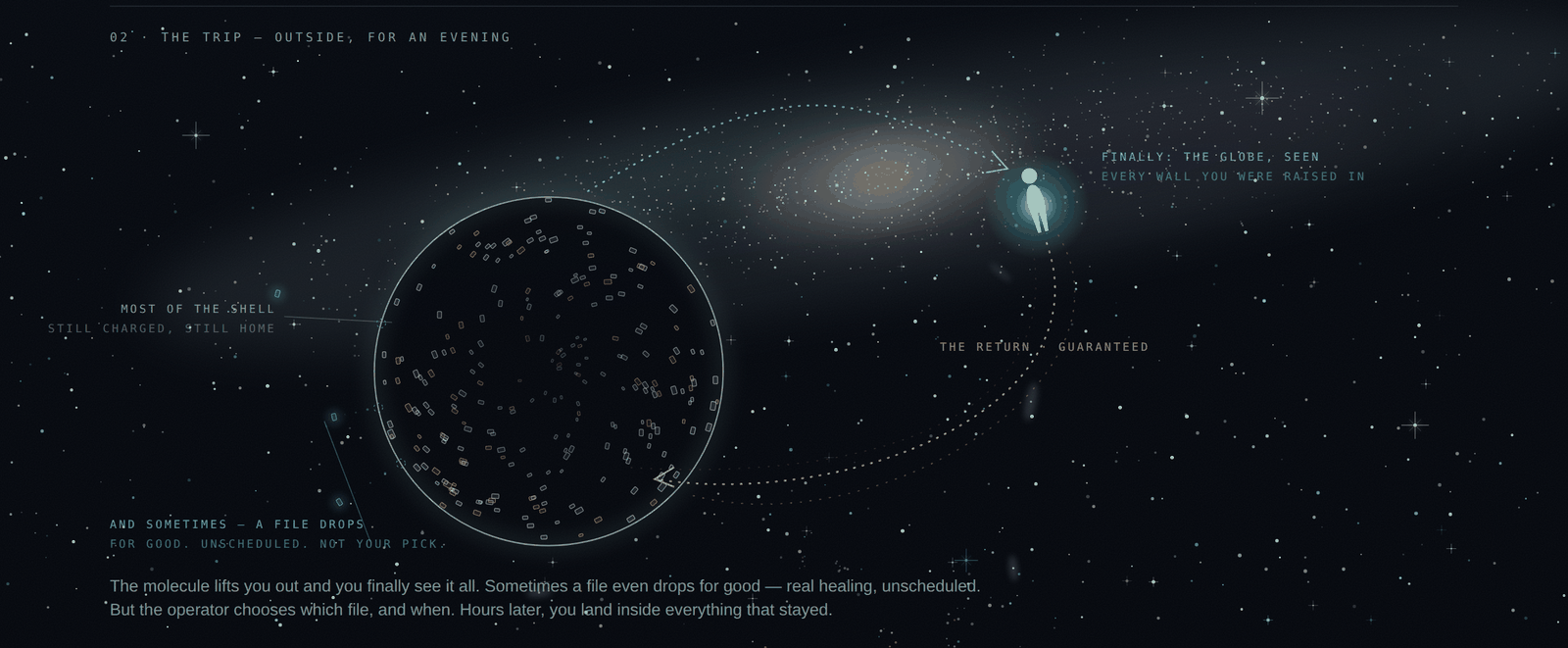
The same globe seen from outside for the first time, a figure floating above it, a dotted arc going out and an amber arc returning; a few files drop away on their own
02 · THE TRIP. The molecule lifts you outside the shell for an evening. For the first time you see the globe as a globe — every wall you were raised in, seen from above. Sometimes a file drops for good: real, unscheduled, not your pick. The return is guaranteed.

This is what the medicine actually does, and it is astonishing: it puts your point of view outside the enclosure. That is why a trip feels like ultimate truth — for a few hours it factually is. And note what the picture makes honest: sometimes the operator does volunteer a file mid-flight, which is why Grof’s cures are real. But you cannot choose which, or when — and hours later you land, gently, back in the middle of everything that stayed charged.
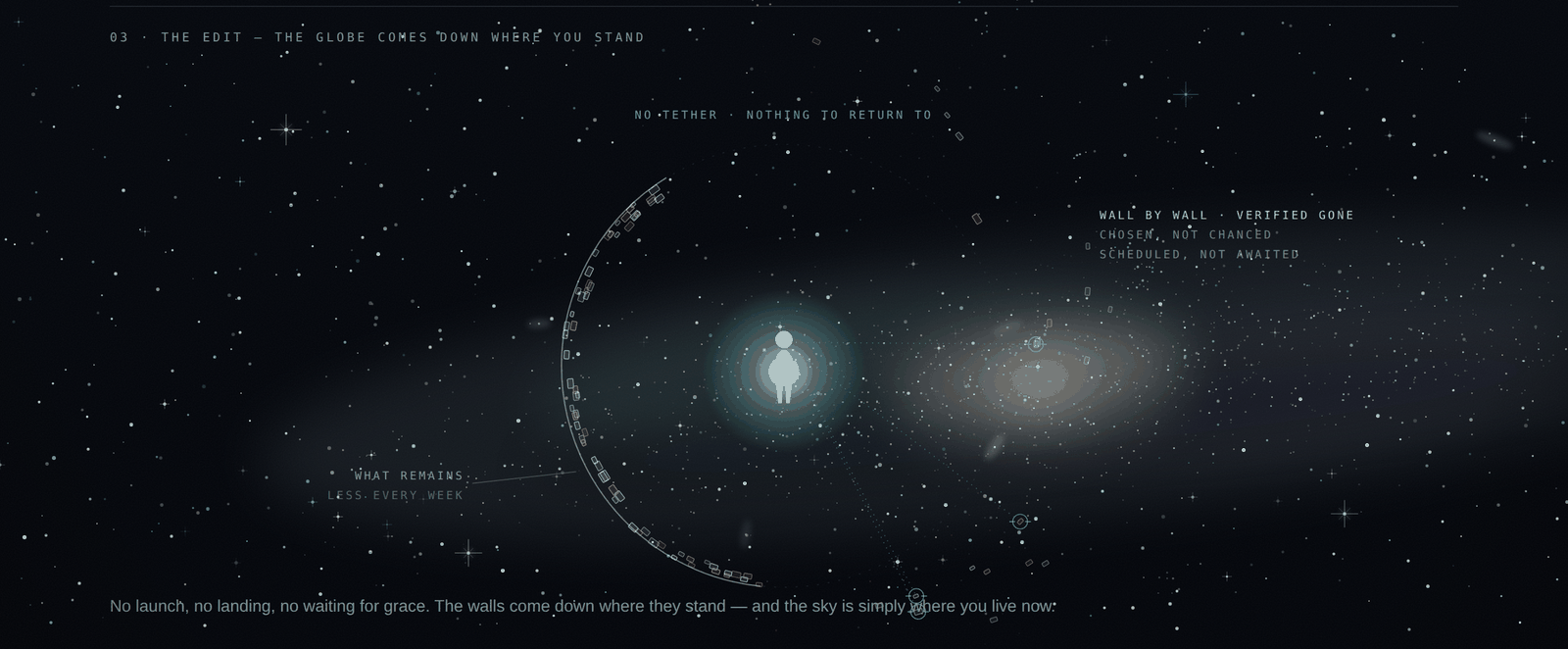
No globe left: the figure stands on the ground while the remaining arc of shell dissolves file by file into star-dust, thin aimed target-lines running from the person to specific files
03 · THE EDIT. No launch, no landing, no waiting for grace. The walls come down where they stand — aimed, file by file, verified gone — until the sky is simply where you live now.

The editing work never leaves the ground. It addresses the wall directly: this file, today — summon it, feel that nothing answers, cross it off. What dissolves does not need to be revisited, because there is no globe left to land back inside of. The trip shows you the shell. The edit is what removes it. They were never competitors; they were never even the same kind of act.

How to run the two together

This is the integration protocol the field never quite wrote down, and it follows from the geometry above.

Treat the medicine as instrumentation, not treatment. Grof named LSD an “unspecific amplifier” and a microscope for the psyche, and he was exactly right. A microscope is not a scalpel. Go in to see — and drop the expectation that seeing will finish anything, which also removes the crash of discovering it didn’t.

During the journey, work like a surveyor, not a patient. When material surfaces, chart it: what conclusion is this file holding? How old? Installed by what event, whose voice? What does it make impossible? You are mapping coordinates on the inside of the shell while you can see them lit.

Write the map down within a day. The trip’s output is not healing; it is a target list of the highest quality obtainable — files you may never have found from the centre, now named and located.

Then, in the weeks after, take the list into the editing work — file by file. Hand each conclusion to the layer that wrote it and have the charge taken out, entry by entry. The test is not insight and not a feeling of peace on the day; it is the summon test: try, on purpose, weeks later, to raise the old charge. When nothing answers, that file is done — and done does not creep back.

Re-test against the world. The mirror is the meter. If life keeps rendering the old scene, that is not proof of failure; it is targeting data — more of the complex is still on the wall than the trip showed you.

Now contrast this with what usually gets called integration. An integration circle has you tell the story of what you saw — valuable for meaning, community, and courage, but narrating a file is not deleting it. Talk therapy analyzes the material with the conscious mind — the fifty-bit channel reasoning about a library it can’t write to. Parts work negotiates with the file — a real improvement in the relationship, which is exactly what Ram Dass achieved, and exactly what remains when the code stays intact.

Story, analysis, negotiation: all conducted from the centre of the globe, aimed at walls that only the operator can actually take down. None of them is deletion. That is why the month-after slide is so universal — the state fades, the set point holds, and the thermostat wins on schedule.

A second first-person note, since I ran both protocols on myself. I have had journeys that felt like the explanation of my life. I saw the events. I saw the files — the actual conclusions, with their install dates. It felt like moving past them, and for about a month everything was great. Then, slowly, they crept back in — and the deeper entity that had written them was still running my outcomes, less than optimally, exactly as before.

What changed everything was flipping the order of operations. I stopped treating the medicine as the treatment and started treating it as the microscope and the amplifier it is — and then, afterward, on the ground, I used the editing technology to blast every file the journey had surfaced, one by one, until I popped through them into pure peace. Internals shifted first. Externals followed. Both stayed.

And I want to be precise, because I did the other things too: it is not the same as talking about your journey in a medicine circle, not the same as taking the material to talk therapy, not the same as parts work. Those handle the story. This deletes the record — like taking a blaster and ctrl-alt-deleting file after file until you pop through the glass you were living inside, and reality is simply there. Clearer. — The practitioner

Quotes: Ram Dass, Be Here Now and later interviews (his “shmoos” teaching); “I had taken LSD 328 times” — his 1966 state-hearing testimony, via the San Francisco Chronicle’s obituary; “afraid of being unloved…” and “it just slowly clings” — interview in The Sun magazine; “old neurotic friends” — ramdass.org. Myron Stolaroff, “Using Psychedelics Wisely” (Gnosis, 1993); Huston Smith, Cleansing the Doors of Perception (via Tricycle); Stanislav Grof’s “unspecific amplifier,” LSD Psychotherapy. Framework concepts from Inner Influencing®, created by Paul Greblick — innerinfluencing.com.

Plant Medicine

Grof’s patients really did heal. Look closer at how.

If you’ve read the last few articles, you could walk away with the wrong impression — that psychedelics never actually fix anything. That impression would not survive contact with Stanislav Grof’s clinical record, and this site has no interest in protecting an argument from evidence. So let’s state the record plainly.

Grof personally conducted or supervised more than four thousand LSD psychotherapy sessions. At Spring Grove, LSD-assisted therapy for alcoholism produced 33% abstinence at six months against 12% for conventional treatment — nearly triple.

Terminal cancer patients got measurable relief from pain and death anxiety that nothing else had touched. And his case files hold genuine cures.

One woman had spent two years in an endogenous depression so heavy it took her hours to get dressed in the morning.

In a five-day workshop she worked through childhood material, relived her birth — and on the last morning something ancient moved through her: spontaneous prayer-like movements, chanting in a language of her ancestors. Grof: “This episode finished these two years of the depression. We saw her then a couple of times at conferences. And the depression never came back.”

Conditions psychiatry had shelved as untreatable — resolved. Sometimes in a single session. So: does that break everything this site has said about awareness not editing code? Look closer at how the healing happened, because the how is the whole story.

Grof’s patients did not heal by seeing their material. They healed when a specific structure — what he called a COEX system, a stack of charged experiences filed under one feeling — came fully up and completed.

His patients called the process “onion peeling of the psyche.” Layer after layer of one file, relived at full intensity, down through childhood and into what he found beneath it, until the charge ran all the way out. When the charge completed, the symptom that charge had been generating stopped being generated.

It’s tempting to stop there and call the completed reliving an edit. We almost did. But there’s a distinction hiding inside Grof’s record that most of the psychedelic world has never made, and it explains everything the “completion” story can’t.

Start with what a psychedelic actually is. Strip away the mythology and one thing remains: heightened awareness. Grof’s own definition — an “unspecific amplifier of mental processes” — says exactly this. The molecule adds no new function to the mind.

It turns the volume up on what’s already there. So reliving a COEX at full intensity is not the file being deleted. It’s the file being played — at maximum volume, through every channel at once: body, emotion, imagery, meaning.

And playback is not editing. If it were, trauma would cure itself: a flashback is full-intensity playback, and people have flashbacks for fifty years without the file losing a volt. Repetition doesn’t delete a recording. Volume doesn’t delete a recording. Nothing about experiencing a file — however completely — rewrites it.

Then what healed the depressed woman? Grof gave the answer without quite naming it.

He marveled that “the process spontaneously… was taking us to the sources” — that the psyche seemed to have its own healing intelligence, and that “when it’s coming up, it’s coming up for healing.” Sit with that phrasing.

Coming up to whom? Not the conscious mind — the conscious mind can only watch it arrive. The system that raised the file is the only system that can re-file it.

Here’s the distinction, then. In the rare, dramatic healings, two things happened, not one. The amplifier played the file — that part the molecule guarantees.

And then, during the playback, the subconscious itself chose to re-conclude: dropped the verdict, released the charge, closed the case. The layer with write access did an edit, on its own initiative, while the file happened to be open. The healing was completely real.

But the editor was never the awareness, and never the molecule. It was the operator — volunteering.

Decades later, neuroscience verified this exact two-part structure under the name memory reconsolidation: a stored emotional learning rewrites only when it is reactivated and met, while open, with a lived disconfirmation — reactivation alone just re-stores it.

Grof’s deepest healings fit this structure precisely: he was producing reconsolidation events decades before the laboratories could name them — he simply had no way to schedule one.

Once you see that, every puzzle in the record solves at once. Why can’t you aim it? Because the operator picks the file. Why did only 33% of Spring Grove clear, with the same molecule and the same skilled team? Because the operator decides whether to re-file, and no dose compels it.

Why did Grof need two sessions a day for years, peeling “layer after layer”? Because he was waiting on volunteer work. Why does an incomplete session leave people worse? Playback started; no re-filing happened; the file was left open on the table.

And it explains the observation that finally forced this distinction on us — from our own practitioner’s journeys and from many others’: sessions that looked like textbook Grof completions — the material fully up, birth-deep, wrung absolutely dry, every box checked — after which the material still had to be addressed by other means.

Full playback with an unchanged conclusion feels almost identical, from the inside, to a genuine re-filing. The catharsis is just as huge. The relief is just as real that night.

Only the following weeks tell you which one you got — because if the verdict didn’t change, the charge quietly rebuilds, and the file goes back on the schedule.

So here is the honest, full statement. Psychedelics are heightened awareness — nothing more, and that is already enormous. Amplified awareness opens files and sometimes plays them end to end, and while a file is open, the subconscious occasionally seizes the moment and does its own edit.

Every genuine healing in Grof’s magnificent record is the operator’s work, done during the molecule’s open-house.

The elders’ intact neuroses, the twelve-week relapse curves, the retreat treadmill — those are all the sessions where the house was open and the owner didn’t renovate.

Which turns Grof’s legacy into a single engineering question. If the subconscious is the only thing that ever edited anything — under LSD, in therapy, on the cushion, ever — then why wait for it to volunteer? Speak to it directly. Give it the address. Ask for the edit.

Verify the charge is gone. Next file. No roulette, no open-house, no waiting for the owner to feel inspired.

That is what the rest of this site is about — and the full comparison across every method that works is here: Every method that works is doing the same thing — slowly.

Sources: Stanislav Grof, LSD Psychotherapy and his 2018 interview with Tim Ferriss (quotes verbatim from the published transcript); Spring Grove alcoholism figures as reported in the study record. Framework concepts from Inner Influencing®, created by Paul Greblick — innerinfluencing.com.

Mechanics

Every method that works is doing the same thing — slowly

Strip the branding off every healing approach that genuinely produces results, and something remarkable appears underneath. Sedona-style releasing. Hawkins’ letting go. Holotropic breathwork. Somatic therapy. Tapping and the energy-psychology family. Acupuncture and qigong moving stagnant qi.

Grof’s amplified sessions. Different centuries, different continents, different cosmologies — and one mechanism: the discharge of suppressed emotional energy.

That convergence is the most important fact in the entire field.

A Czech psychiatrist with LSD, a physicist dying in Manhattan, Chinese medicine three thousand years ago, a monk with a breathing practice — every serious lineage, digging independently, hit the same thing: stored charge is what runs the show, and moving it out is what changes lives. When this many traditions agree on the enemy, believe them.

So let’s say it without hedging: these methods work. Releasing works. Letting go works. Breathwork works. The needles and the tapping and the ceremonies work. Anyone who tells you otherwise hasn’t done them.

The question this article asks is different, and it’s the question nobody in the field wants to sit with: what do they cost per unit of charge — and what’s the total bill when the warehouse is full?

Look at the engineering shared by every one of them. In the discharge paradigm, the energy leaves through experience.

To drain a feeling you must feel it and let it leave — two different acts, as we’re about to see — or run it out through the body, which you also experience. Every method on the list routes the material through the same exit: conscious felt awareness.

The fifty-bits-per-second channel. One feeling at a time, at survivable intensity, while you’re present and willing.

And right here sits the distinction the entire field trips over — the one that looks like a contradiction until you see it: feeling is the exit. Feeling is not the drain.

Experience is the channel the charge must pass through on its way out — but passing through only happens when a second, separate act opens the valve: the letting-go, the welcoming, the dropped resistance, the completed response.

Feel a feeling without that act, at any intensity, for any number of years, and nothing leaves the file itself. You’ve paid the toll and moved no water.

You’ve already met the proof, in The elders came down. Ram Dass ran maximum amplification hundreds of times, then sat nineteen years on the cushion — and reported every neurosis intact. Look at his toolkit and there’s no mystery.

Psychedelic observation. Devotion. And a meditation whose entire instruction is a shift of identification — label the thought, rest as loving awareness, be “the witness of your incarnation.” Every instrument the man owned was a seeing instrument.

None of them was a valve. He experienced his material as completely as any human ever has and released almost none of it — which is exactly what this model predicts, and exactly what he reported.

Now, be careful — because awareness clearly does something. Grof’s patients moved forward even between the dramatic cures. Exposure therapy works well enough to be the standard of care. Ram Dass suffered visibly less at seventy than at thirty.

If pure awareness drained literally nothing, none of that could happen. It turns out science has mapped exactly what witnessing does — four real things — and not one of them is draining the primary file.

It regulates. Naming and observing a feeling calms the alarm in the moment — measurably. Real relief, right now, at the state level. The file: untouched. Come back tomorrow and the alarm is available again.

It writes counter-code. This one is the quiet bombshell from modern exposure research.

Repeated safe exposure to feared material does not erase the original learning — the finding, in the researchers’ own words, is that “the original excitatory response is not erased”; instead the system writes a new, competing fileand yet I’m safe — that suppresses the old one’s expression.

That’s genuine functional improvement, and it’s why the gains are famously fragile: change the context, add enough stress, wait long enough, and the original — still fully intact underneath — resurfaces.

The clinical literature has names for the return: spontaneous recovery, renewal, reinstatement. Awareness didn’t drain the old code. It stacked new code on top — an overlay that needs maintenance, forever, because the thing it’s overriding is still there.

It drains the second arrow. Every charged file carries a second layer of charge about the first: the fear of the feeling, the shame about the pattern, the resistance to the material.

Witnessing genuinely dissolves that meta-layer — and here is Ram Dass, explained to the last decimal. Primary files: intact, by his own count, every one.

The terror and self-condemnation about them: gone — that’s what “huge, frightening things” becoming “little friendly beings I invite in for tea” is. His transformation was completely real.

It was a full drain of the second story of the building — with the first story untouched. Fifty years of awareness practice buys you a beautiful relationship to your code. It reported, honestly, exactly that.

And it opens the vault. Here is the deepest one, and it closes the circle on Grof.

Neuroscience has verified exactly one mechanism that actually erases an emotional learning — memory reconsolidation — and it has two requirements: the file must be reactivated, and while it’s open, the system must meet a vivid, lived disconfirmation of what the file asserts.

Reactivation alone — re-experiencing, however intense — re-stores the file unchanged. But reactivation plus mismatch rewrites it before it re-stores.

Now re-read Grof’s sessions: massive reactivation, guaranteed by the amplifier — and every so often, by grace of the session’s content, a lived disconfirmation arrives at the same moment. You relive the terror while held in absolute safety.

You die in the experience and don’t die. Mismatch fires, the file rewrites — and the depression never comes back. When the disconfirmation doesn’t happen to arrive: playback, re-stored, next ceremony. The operator volunteering has a laboratory name.

And notice what the science just conceded: repetition doesn’t erase. Activation plus disconfirmation at the storage layer does. That is a definition of an edit.

So keep three tiers straight, because everything on this site sorts into them.

Awareness plays the file — regulating the moment, stacking counter-code, softening the second arrow, sometimes opening the vault — but never draining the primary file itself; that’s the flashback, the witness, most journeys.

Discharge is feeling plus the valve — Sedona’s “could you let it go?”, Hawkins’ dropped resistance, the somatic completion, the release that sometimes fires spontaneously mid-ceremony — real drainage, through the narrow channel, one felt instance at a time.

Editing changes the conclusion at the source, and the charge never has to pass through you at all. The methods in this article’s opening list are the ones that found the valve — that’s why they work.

The rest of this article is about why even that tier — the honest, working tier — cannot finish the job.

Now put the two numbers next to each other. The reservoir was written by a system processing millions of bits per second, continuously, for decades. The drain runs at fifty.

That is not a flaw in any particular technique — Sedona didn’t do it wrong, Hawkins didn’t do it wrong, the shamans didn’t do it wrong.

It is the arithmetic of the paradigm itself: an ocean, draining through a straw, and every method in the family is a different grip on the same straw.

The unit economics follow.

In discharge, the cost is proportional to the charge: you pay for every unit of stored energy on its way out, in felt experience — that’s what “stay with the sensation until it exhausts itself” means, that’s what an eight-hour ceremony is.

Retail price, paid in you. Now notice something about actual computers: deleting a file does not require playing it. The cost of an edit is proportional to the instruction, not the archive. Two hundred hours of video: hours to watch, a second to delete. Every discharge method makes you watch.

Next: the paradigm has no address system. Discharge can only work on material that presents — and presenting is exactly what the suppression system was built to prevent. So you don’t heal in order of importance.

You heal in order of ambush: whatever a trigger, a session, or a molecule happens to shake loose this week. The releasing traditions release what’s up. Grof’s amplifier played what the psyche picked.

Nobody gets to say “the money file, please” — because no method in the paradigm can query the index. Only the system that wrote the index can search it.

Then the generator problem. A feeling is a printout; the conclusion underneath is the printer. Drain the tray and the printer prints again — the same trigger re-secretes the same charge from the intact verdict.

This is the fine print in Lester Levenson’s own protocol that parts of his lineage quietly dropped: Lester didn’t just release the feeling — he went back and corrected the record, memory by memory, want by want. Releasing was his pump. Re-concluding was his edit.

Keep the pump and skip the edit, and you get the experience thousands of dedicated releasers know and rarely say out loud: the same material, back on the bench, year after year.

And the deepest one: charge isn’t stored in one tank. It’s cross-filed — one conclusion threaded through hundreds of memories, each reinforcing the rest. Discharge drains the instance in front of you; the network re-inflates it from every connected file.

This is why sincere people with heavy histories find the work endless — not approximately endless, structurally endless. You are bailing a bay that’s connected to the sea. The unit that has to change was never the episode.

It’s the conclusion the episodes are filed under — and only an edit operates at that level.

A word on the energy-healing and Eastern-medicine end of the family, because the relief there is real and deserves respect: moving stagnant energy genuinely moves it, and the system runs better with the current flowing. But watch what happens over months. The same blockage, back in the same place.

The practitioner becomes an appointment, not an event. Same generator problem, one layer down: the flow was treated; the spec that keeps calling for the blockage was not.

And there’s no endpoint — no test that says done — which is how maintenance quietly becomes a lifestyle.

Add it up. Channel-limited. Retail-priced. Ambush-ordered. Generator intact. Network refilling behind you. And all of it performed by the five percent — the conscious mind doing manual labor, one armful at a time, in a warehouse owned and restocked by the ninety-five.

The ratio that makes your patterns unbeatable in daily life is the same ratio that makes manual clearing hopeless at scale. The discharge paradigm doesn’t fail. It just can’t finish.

Which is the whole case for the other paradigm — not a better pump, a different job description. Stop moving the water yourself. Change the spec that calls for water.

The editing approach puts the ninety-five percent to work instead of fighting it: the system that wrote the files, holds the index, and runs millions of bits per second does the searching and the un-concluding — by category, not by episode; at the cost of an instruction, not the cost of reliving; in importance-order, because you choose the address; with a real endpoint, because you can test for the charge and find it gone.

The material doesn’t have to pass through you on its way out. It was never your job to carry it. It was your job to order the recall.

The editing paradigm, its targeting approach, and the framework concepts are from Inner Influencing®, created by Paul Greblick — innerinfluencing.com. Lester Levenson’s protocol per his autobiography, No Attachments, No Aversions. Science: the inhibitory-learning model of exposure (Craske et al.) — extinction does not erase the original learning; and the memory-reconsolidation literature (Nader; Ecker et al., Unlocking the Emotional Brain) — erasure requires reactivation plus disconfirmation. Ram Dass’s witness practice per his foundation’s published teachings.

Depth Psychology

Making the unconscious conscious — then what?

Start with a correction. The Jung quote everyone knows — “until you make the unconscious conscious, it will direct your life and you will call it fate” — is a paraphrase. Jung never wrote it.

What he actually wrote, in Aion, is sharper: “The psychological rule says that when an inner situation is not made conscious, it happens outside, as fate.”

Read that as an engineer. An uncleared inner situation doesn’t just influence your life. It happens outside. It renders. Jung stated the core principle of this entire site — inner code, outer printout — in 1951, in one sentence.

And he didn’t just theorize it. He measured it. In his word-association experiments, Jung read patients a list of ordinary words and timed their responses with a stopwatch, tracking hesitations, blanks, and skin response. Certain words snagged — measurably, repeatably.

He called what the snags revealed feeling-toned complexes: clusters of charged material, organized around a wound, that in his own description behave like independent beings. His term for them was splinter psyches.

A century ago, with a stopwatch, Jung empirically detected charged files — autonomous programs, with their own agendas, interfering with the conscious will and projecting themselves onto the world as fate.

The map is magnificent, and it matches everything on this site. Complexes are the tags. Grof’s COEX systems are complexes traced deeper. Same territory, surveyed three times, three vocabularies.

Now look at Jung’s prescription: make it conscious. Dreams as the royal road. Active imagination — sit down and dialogue with the figures. Amplification, shadow work, withdrawing projections. Individuation: the lifelong widening of consciousness to include what was operating in the dark. The goal, famously, wholeness — not perfection.

Watch the word integration closely, though, because it means exactly what it says: relationship, not removal. The complex is met, named, dialogued with, given its seat at the table. It is not deleted.

Jung was completely honest about this: “The greatest and most important problems of life are all fundamentally insoluble… They can never be solved, but only outgrown.”

In this site’s tier language: Jungian analysis is the deepest, most beautiful awareness apparatus ever constructed. It maps, names, and relates; it stacks counter-code; it drains the second arrow with real skill.

And it produces exactly what it promises — a more aware, more compassionate, stronger version of the same self, presiding with wisdom over the same complexes.

Which brings in the psychedelics, because the tie is direct. Grof’s entire framework is explicitly Jungian — archetypes, the collective unconscious, the psyche’s own healing intent.

The molecule is Jung’s royal road, paved into a highway: what dream analysis surfaces in a decade, one amplified session surfaces in an afternoon. Same axiom underneath — consciousness of the material is the healing agent. Same operation: read.

And here is the part almost nobody knows. Jung was offered the highway — and refused it. When mescaline research reached him in 1954, he wrote: “There is no point in wishing to know more of the collective unconscious than one gets through dreams.”

Knowing more, he warned, only raises the debt: “the greater and heavier becomes your moral burden, because the unconscious contents transform themselves into your individual tasks.”

Every file you open becomes your job to process. Surface faster than you can integrate, and you haven’t healed more — you’ve taken on more cases. Anyone who has come home from a ceremony with new rooms of material and no way to close them has lived Jung’s warning.

The endless ocean isn’t a failure of the medicine. It’s the medicine outrunning the integration — exactly as predicted, in 1954.

Then Jung delivered the single most precise critique of the psychedelic path ever written. Of Aldous Huxley and mescaline, he said Huxley was the sorcerer’s apprentice, who “learned… how to call the ghosts, but did not know how to get rid of them.”

Sit with that sentence. The century’s greatest cartographer of the unconscious, looking at the amplifier, names the exact gap this site is built on: calling ghosts and getting rid of ghosts are two different arts. The molecule calls — magnificently. Nothing in the paradigm banishes.

But honesty cuts both ways, so turn the same question on Jung: what was his art of getting rid of ghosts? He didn’t have one either. His method calls them slower — at dream pace, which is wiser — and then relates to them, beautifully, forever.

Outgrown, not solved is a cartographer’s surrender, stated with perfect integrity. The consulting room and the ceremony read at different speeds. Neither one has a delete function.

So the optimal approach keeps everything Jung got right — which is nearly everything. Keep the map: complexes are autonomous charged programs; he proved it with a stopwatch. Keep the rule: uncleared inner situations happen outside, as fate.

Keep the pacing wisdom: never open more than can be processed — and note that the editing approach honors this completely, because nothing has to be relived, re-experienced, or held open at all.

Then add the one operation his toolkit lacked: reverse the traffic. Jung’s method drags contents up into the small light, to be seen by the reader.

The edit sends the instruction down — to the layer that owns the complexes, the only layer with write access — to un-conclude them: by address, one at a time, checked afterward by the only test that matters, whether the charge can still be found.

Making the unconscious conscious was the greatest reading program ever devised. The optimal approach is a writing program.

And it ends where Jung was aiming all along: at the Self beneath the complexes — reached not by presiding over them more wisely, but by there being, one file at a time, less and less to preside over.

His own rule, run in reverse, is the whole promise: change the inner situation at the source, and watch what stops happening outside.

Jung quotes: Aion (Collected Works 9ii); his 1954 letter on mescaline research (Letters, to Victor White); complex theory per A Review of the Complex Theory (CW 8); “solved… only outgrown” from his commentary on The Secret of the Golden Flower. The “direct your life… call it fate” version is a popular paraphrase, not Jung’s wording. Framework concepts from Inner Influencing®, created by Paul Greblick — innerinfluencing.com.

Depth Psychology

The pain that arrived before you did

Two of the last century’s great cartographers mapped the same disturbing territory from opposite ends. Eckhart Tolle, describing what he calls the pain-body, mapped it from the inside — as lived experience.

Carl Jung, describing the collective unconscious, mapped it from underneath — as inherited architecture. Put their maps together and something uncomfortable comes into focus: a large share of the code running you was written before you were born.

Start with Tolle, and take him literally, because he means it literally: “The pain-body is my term for the accumulation of old emotional pain that almost all people carry in their energy field… I see it as a semi-autonomous psychic entity.”

Every strong emotion that was never fully faced didn’t evaporate. It accumulated — into something with, in his words, a life of its own.

And this entity has a metabolism. “The pain-body has a dormant stage and an active stage. Periodically it becomes activated, and when it does, it seeks more suffering to feed on… Every negative thought has a similar frequency to the pain-body and so feeds it. It cannot feed on positive thoughts.”

Read that as an engineer and the hair should stand up on your neck: he’s describing a self-provisioning process. Accumulated charge that generates the very emotions it consumes.

It doesn’t wait for bad days — it manufactures them, on a feeding schedule, and the mood arrives before any cause. If you’ve ever woken up spoiling for a fight with no fight in sight, you’ve felt the process wake up hungry.

Then the line that explains a thousand ruined evenings: “If you are not absolutely present, it takes over your mind.” The voice changes. Sentences come out that “you” don’t mean, in a tone you barely recognize, replaying arguments word-for-word from years ago.

That isn’t you at your worst. That’s the code speaking as you — the defense-system disguise, at full volume.

Couples know the two-player version: the fight that arrives on schedule, over nothing, where the irritability shows up before any trigger and goes hunting for one — two accumulations on synchronized feeding cycles, catering for each other.

Now the deeper layer. Tolle: “There is also a collective human pain-body containing the pain suffered by countless human beings throughout history” — and beneath the personal accumulation sit group accumulations: peoples, nations, lineages, the long female line.

This is where Jung supplies the architecture: beneath your personal unconscious lies the collective layer — inherited structures, older than any memory of yours, that shape what a mind expects, fears, and concludes.

Your complexes, Jung found, have archetypal cores: personal charge, wrapped around pre-personal charge.

Here’s the mechanism by which the old layers set your code. A child in the install window absorbs the house wholesale — not just events, but tones, silences, flinches, the weather of the rooms.

But the house itself was running libraries: the family’s accumulated charge, and under that, the culture’s. So the child’s “personal” conclusions get drawn inside pre-cut grooves. You didn’t just inherit your eye color. You inherited the menu of conclusions available to draw.

So how do the old layers actually operate on you, mechanically? Three ways. Transmission: the install window absorbs the house’s charge directly — no events required; the tension in the room was enough.

The groove: when your own hard moments arrived, the conclusions you drew were the ones the libraries made available — a child of the scarcity line concludes there won’t be enough from a late allowance.

The feed: once installed, the process seeks experiences matching its frequency — the Law of Repulsion with an appetite.

Remember Tolle’s line that the pain-body “cannot feed on positive thoughts,” then notice what an algorithmic news feed optimized for engagement actually serves: the collective fear-body found an all-night kitchen. The code doesn’t just filter your life. It caters its own meals from it.

Let’s make the installation concrete, because “collective code” sounds abstract until you see your own coordinates in it. A tag is a conclusion with charge attached, filed as operating truth. Personal tags come from your events.

Collective tags come from your coordinates — where you were born, where your parents were born, what you look like, what language your home ran on. No event in your life required.

The country file.

Born into a lineage from a place with a history of invasion, collapse, or flight, and you may carry safety is temporary — keep a bag packed: rendering as the inability to fully commit to anything, savings that hoard rather than build, good opportunities read as traps.

Parents from an economy that collapsed overnight carry money vanishes — and their child panics at spending while objectively wealthy.

A long line of laborers carries our kind works with our hands; wealth is for other people — a ceiling on ambition that presents, very convincingly, as realism.

The skin file. Some tags are installed from inside the group — inherited vigilance, you must be twice as good, don’t get too visible — protective conclusions earned by generations for whom they were accurate.

Others are installed by the surrounding culture’s projections, absorbed in the install window like everything else.

Together they render as shrinking in rooms you’ve earned your place in, sabotage precisely at thresholds of prominence, and the ambient exhaustion of a system that never fully stands down. The charge is real, it was installed, and none of it was concluded by you.

The second-generation file — the most precise case study there is. The parents grew up there; the child grows up here; and the child ends up running two operating systems at once.

From home, transmitted whole in the install window: the old country’s scarcity, its hierarchies, keep your head down in someone else’s country — plus the heaviest tag of all, achievement as loan repayment: we didn’t sacrifice everything for you to take risks.

From outside: the new country’s menu, plus not fully from here — the between-worlds tag, not quite enough for either side.

Watch what that dual install renders: over-achievement that never satisfies, because a loan payment isn’t income; guilt at any ease the parents never had; the “safe” prestige career that feeds the family file and starves the person; exhaustion from switching operating systems at every door. The parents and the child share a house and run different code — and neither chose a line of it.

And here is where the energetic framing earns its keep. Each of these tags is a conclusion held with charge — and charge, as everything on this site argues, broadcasts. The tag doesn’t just color what you perceive; it participates in what you meet.

The system renders, attracts, and repels in conformity with the conclusion — which is why lineages have “family luck,” why the same fate seems to find each generation on schedule. It isn’t fate finding them. It’s the file, broadcasting on the frequency it was tuned to before they were born.

Now — before this becomes the heaviest thing you’ve ever read — turn it over, because there’s a trapdoor built into every collective file, and it’s the most liberating mechanism on this site. Every collective tag masquerades as a law: people like us don’t. But laws don’t have exceptions. Settings do.

And every single collective conclusion has living exceptions. The person from your country who built the thing. The person your color who owns the room without armor. The child of immigrants who took the risk, thrived, and feels no debt.

The one from your exact starting line — your block, your accent, your family’s money — living what the file says people like you don’t get. Somewhere, always, without exception, there is an exception.

Sit with what that proves. The collective file’s entire authority rests on precedent — this is what happens to us.

But the subconscious runs on precedent too — if one person has done it, it’s the standard — which means a single counterexample is not an anomaly. It’s a filing error in the law’s favor, corrected.

The exception doesn’t erase the group’s history, which is real. It erases the sentence’s claim to be about you.

Notice how the file defends itself, though — because it will. The moment you see the exception, the code discounts them: they’re different, they got lucky, they had help, they’re not really like us. That discounting reflex is not your judgment.

It’s the file protecting its own precedent — a law that has to disqualify its counterexamples to stay a law was never a law. The discounting itself is a target, and often the load-bearing one.

And the deepest turn: whoever clears an inherited file becomes the exception — the lineage’s Bannister. Their life enters the menu of conclusions available to everyone downstream and everyone watching.

One person breaking a generational pattern doesn’t escape the collective code. They amend it.

Which is what the one-person standard was always really about: exceptions exist to every rule; therefore every rule is a setting; therefore the collective layer — the oldest, most fated-feeling code a person carries — is exactly as editable as a phobia. It just has more people waiting on the edit.

Tolle’s remedy deserves an honest reading, because it’s the best move in the awareness tier: presence. “We release it by cutting the link between the pain-body and our thought processes, so that we no longer feed the pain-body with our thinking.”

And this genuinely works — on the feeding. Presence interrupts the active phase, stops new accumulation, ends the possession episodes. If you learn one thing from Tolle, learn that.

But notice what starvation is: a siege. The accumulated archive — personal, family, collective — sits in storage, dormant, patient, waiting out your presence practice. Sieges are long, and the older the store, the longer the siege.

Which is why the pain-body survives decades of sincere witnessing: the link gets cut and re-formed, cut and re-formed, and the reservoir underneath never drains.

The editing paradigm’s answer follows from everything else on this site: address the stored material directly — including the material that’s older than you.

Because here’s the fact the inherited layers don’t want you to notice: however ancient the file’s origin, it is running in your system, now — a file like any other, holding charge like any other, editable like any other. Provenance doesn’t grant immunity. The subconscious doesn’t check a file’s birth certificate before releasing it.

Which leaves the strangest, most hopeful fact in this whole territory. You are not the origin of most of what you carry — and you are the first person in your line with a way to address it. Your grandmother couldn’t edit the famine.

Your line’s women couldn’t edit the swallowed voices. You can. Clearing an inherited file is the one gift that travels in both directions — backward, as the ending the old pain never got, and forward, as the code your children never run.

Eckhart Tolle quotes on the pain-body from his published teachings (The Power of Now, A New Earth, and interviews). Jung: collective unconscious and archetypal cores of complexes, Collected Works. Framework concepts from Inner Influencing®, created by Paul Greblick — innerinfluencing.com.

The Field

The notes everyone can read but you

Here is one of the stranger concepts in the framework this practice uses, and one of the most explanatory once it lands: everyone is walking around wearing notes. Invisible ones — hit me. Ignore me. Don’t take me seriously. Overlook me. Take advantage of me. Treat me exactly like this. You can’t see yours. Everyone else reads them on contact.

Not consciously. Nobody walks into a meeting, scans your field, and decides to talk over you.

But you already know the reading happens, because you do it too: some people walk into a room and something in you eases; others walk in and something tightens — before a word is spoken, before you’ve formed a single opinion. You never decided any of that. You read a broadcast. Others are reading yours.

The framework’s account is physical, not poetic: the nervous system is a broadcasting station, and stored charge shapes the signal. Whatever conclusions the subconscious holds — I get overlooked, I get left, people like me get targeted — are transmitted continuously.

And here is the uncomfortable completion of the loop: people don’t treat you the way you ask. They treat you the way your field instructs. They sense the charge, and they play you that way.

Suddenly a whole class of otherwise baffling patterns gets a mechanism. Why one person is hassled, scammed, and picked on in every city they visit, while another walks anywhere untouched. Why bullies in every new school find the same kid by day two.

Why some people’s boundaries are violated no matter how firmly they state them — the note outranks the words. Why you can change your clothes, your title, your city, your posture — and the world keeps responding to something underneath all of it.

Now connect this to the inherited layers, because here’s the part that matters most: many of your notes were written before you were born. The second-generation kid wearing his parents’ keep your head down in someone else’s country.

The daughter wearing the family line’s my needs go last. The one wearing a people’s expect to be targeted. Nobody chose these.

They were transmitted whole, in the install window — and the world has been reading them off you ever since, treating you according to instructions your grandparents’ circumstances wrote.

This also explains the cruelest feature of anticipated mistreatment: imaginary sources carry real charge. The rejection you’re braced for, the disrespect you’re expecting, the hostility you’ve pre-loaded — none of it has to have happened today to be broadcasting today.

The anticipation itself is a note. And the broadcast tends to get answered — which the file then records as proof.

So what happens when a note comes off — when the charge underneath it actually clears? Something almost eerie, which people who’ve done deep clearing report with remarkable consistency: the world changes its behavior without being told anything. The colleague stops testing you.

The rooms that talked over you start turning toward you. The category of stranger who always found you stops finding you.

The framework marks this with an honest and very specific observation: sometimes, after extensive clearing, a difficult person becomes warm and easy toward you specifically — while remaining exactly who they were to everyone else. Read that precisely.

Their character didn’t change. Your field stopped offering the hooks their pattern runs on. The pattern isn’t gone; it’s gone in your direction. Which is the cleanest evidence there is for which side of the interaction the note was on.

And this is where the exceptions come in — the people the collective rules visibly failed to apply to. History keeps producing them, and read through this lens they stop being miracles and become data.

Nelson Mandela walked into prison carrying every note his circumstances could write — and somewhere across twenty-seven years, took them off. The result was one of the most documented field-effects in modern history: his jailers changed toward him.

Warders became friends; one later wrote a book about their friendship; he famously invited a former prison guard to his inauguration. The system around him remained what it was — toward him specifically, it could no longer run its pattern.

He said it himself, in his own way: staying resentful would have kept him a prisoner after he was free. He declined to wear the note.

Oprah Winfrey’s coordinates — Black, female, poor, rural Mississippi, an abusive childhood — carried a full stack of collective files, every one of them broadcasting not for you.

Whatever else explains her, this much is observable: the notes stopped being read off her decades ago, and an audience of every color and class spent twenty-five years turning toward her the moment she walked into the room. The collective rule didn’t bend for her. It simply wasn’t transmitted.

Arnold Schwarzenegger arrived wearing what should have been permanent notes — immigrant, impenetrable accent, unpronounceable name, wrong body for leading man. Every gatekeeper who read those notes said the same thing: impossible.

The notes he was actually broadcasting evidently said something else — and the industry ended up rewriting its own rules around him, then the state of California did it again.

Notice what your code does the instant it meets these people: they’re exceptional, they’re one in a billion, that’s not evidence. That reflex is the file protecting its precedent.

The accurate reading is the opposite: the collective rule is a note, notes are charge, charge can clear — and every person walking around un-played by a rule that plays everyone else is a live demonstration, in public, of what a field without that note gets treated like.

The practical shape of the work, per the framework: the notes come off one at a time — each cleared incident, each cleared theme, peels one. And the endpoint isn’t a technique for managing how people treat you.

It’s a field with nothing written on it that instructs anyone to treat you as anything less than what you are — at which point the reading never stops. It just finally reads something true.

The post-it, broadcast-reading, and field concepts are from the Inner Influencing® framework, created by Paul Greblick — innerinfluencing.com. Mandela’s friendships with his warders are documented in Christo Brand’s Mandela: My Prisoner, My Friend and contemporaneous accounts of his inauguration.

The Field

Same coordinates, different universe

The last two articles were halves of one machine. One showed what you inherit — the charge that arrived before you did. One showed what you transmit — the notes everyone reads but you.

This article is about how they assemble into a single stack in the unconscious — and about the strangest, most testable claim on this site: when the stack clears, your life transforms while every tangible fact about you stays exactly the same.

Build the stack from the bottom. Layer one: the coordinates. Skin color. Ancestry. Religion. Immigrant status. Sex. The body you were issued. These are facts — and here is the first thing to notice about facts: a fact carries no instruction. A coordinate, by itself, tells nobody how to treat you and tells your nervous system nothing about what to expect.

Layer two: the files about the coordinates.

This is where the collective and family material lands — conclusions about what people like you get, installed in the download window before you could evaluate a word: what your line survived, what your people expect, what the surrounding culture projects. The coordinate is neutral. The file about it is loaded — and you didn’t write it.

Layer three: your episodes. Then life happens — and every incident that touches a coordinate gets filed into its pre-cut groove.

The slight at the counter, the look on the street, the interview that went cold: each lands not as a single event but as the next episode of the archive, confirming it, thickening it. The menu of available conclusions was set before your first conclusion.

Layer four: the metabolism. The accumulated charge doesn’t sit inert — it feeds. It pre-interprets neutral events into episodes, seeks the frequencies that match it, and generates the emotion it consumes. By adulthood the stack runs itself: it doesn’t need new mistreatment to produce the experience of mistreatment. The archive prints it on schedule.

Layer five: the broadcast. The whole stack transmits. It’s the note on your back — the bracing, the expectation, the pre-loaded verdicts — and people play you the way it instructs, which produces fresh episodes, which get filed as proof.

Close the loop and look at it whole: inheritance → interpretation → accumulation → broadcast → confirmation → deeper filing. One machine, self-fueling, running on your energy budget.

Now the distinction the whole article turns on: the coordinate and the charge on the coordinate are different objects. And there’s a clean proof: variance.

Take two people with identical coordinates — same color, same faith, same ancestry, same immigration story, same neighborhood — and you will find opposite lives: one braced, one at ease; one hassled everywhere, one somehow untouched; one for whom the identity is a weight, one for whom it’s a home.

If the coordinate caused the experience, that variance would be impossible. The coordinate is shared. The stack is individual.

Living inside the full stack feels like this: nothing is ever just an event. Everything arrives pre-interpreted. The world seems to confirm the files daily — because the loop manufactures its own confirmations — and since the code presents as perception, none of this feels like software. It feels like the way things are for someone like me.

Then the right tools reach the stack — and here is what actually changes, stated carefully, because it’s stranger than any promise of new circumstances. Nothing tangible changes. Same face in the mirror. Same name, same accent, same ancestry, same passport, same skin, same street. Every coordinate the world can see: identical.

And: events start arriving as just events. The counter clerk is having a day, not delivering a verdict. The interview is one interview, not the archive’s next episode.

The ambient bracing — which you never noticed because it was always on — stands down, and an energy you didn’t know you were spending comes back. The feed starves. The Tuesday that would have wounded you renders as an ordinary Tuesday.

Then the outer layer follows, on the mechanism the notes article laid out: the broadcast has changed, so the reading changes, so the treatment changes — rooms turn toward you, the tests stop, the category of trouble that always found you loses your address.

Same coordinates, being read by the same world — and the world reads something else off them now, because what it was reading was never the coordinates.

And be clear about the strength of this claim, because it is easy to undersell: people factually treat you differently. Not “you experience the same treatment more calmly” — differently.

The framework’s most striking field observation says exactly this: after deep clearing, the difficult person becomes warm toward you specifically, because the pattern they run on everyone else can no longer run on you. Toward you, they are observably someone else.

The relative says the kind thing they never say. The room makes space it never made. The treatment itself changes — that is the claim, and it is meant literally.

The vibrational traditions state the mechanism at its cleanest: circumstances — including how people behave toward you — are reflective. They take their cue from the state of the one meeting them, the way a mirror takes its cue from the face. The reflection has no will of its own.

Nobody ever meets “the world”; each person meets the version of the world that matches their stack.

Apply that to people. Everyone you know contains many versions of themselves — the impatient one, the generous one, the dismissive one, the warm one. Which version walks into the room with you is not fixed. It is selected — by what your field offers to reflect.

Clear the stack and you don’t get better at enduring the old treatment. You stop meeting it. Same person, different version — because the version that met you was always a reflection.

One precision will save you from a classic despair: what to do when the world hasn’t changed yet.

Some traditions answer hold your new state on faith — but holding is willpower, the five percent arm-wrestling the ninety-five, and a genuinely cleared file needs no holding, because nothing is left pulling.

The framework’s answer is colder and kinder: an unchanged mirror is targeting data. Either the file was a rest, not a release — test it. Or the series is longer than the episode you cleared — sweep it.

Or — the sneaky one — you now have fresh charge about the unchanged world (it didn’t work, they’re still doing it), and that file is re-anchoring the very reflection you’re watching.

The test that separates real delay from remaining charge is your own reaction. Ordinary latency exists — pipelines, other people’s calendars, a process that takes three weeks no matter what.

If the lag leaves you genuinely nonchalant — big-nothing nonchalant — the file is done and what remains is shipping time. If the lag bothers you, the bother is charge, the charge is the anchor, and the mirror is still reflecting it. The echo isn’t something to endure on faith. It’s the next target, wearing a disguise.

What remains is only what was never yours: the past stays happened, and what people do in rooms you’re not in was never your experience anyway.

But for the life you actually live, the claim is total — the treatment you meet, the behavior that finds you, the version of every person who shows up to meet you: those follow the stack. The exceptions in the last article weren’t enduring the same world with better attitudes. They were being met by a different world — on the same coordinates.

Which yields the claim in its final, testable form. You don’t need new coordinates, and you couldn’t get them anyway. You need the stack cleared — and when it is, you get the only upgrade that was ever actually on offer: a new universe at the same address.

Identical tangibles, transformed experience — and then, as the render catches up, transformed circumstances too. If that sounds too strange to believe, good: it’s checkable. Clear one file about one coordinate, and watch what one week of the same life feels like.

The stack, broadcast, and clearing concepts are from the Inner Influencing® framework, created by Paul Greblick — innerinfluencing.com. Pain-body concept: Eckhart Tolle; collective unconscious: C.G. Jung — see the two preceding articles. The reflection and vibratory-mechanics framing draws on contemporary vibrational teachings, including Bentinho Massaro’s empowerment lessons.

Case File

The ceiling that was never about money

A composite. Assembled from the way this pattern typically presents — not a transcript, and no individual’s material appears here. The mechanics are the point; the person is a stand-in for a very large number of people.

The complaint. Thirty-eight. Good at the work, genuinely good — the kind of good where clients refer him without being asked. And for six years his income has sat in the same narrow band. Nine to eleven thousand a month. Not poor. Stuck.

He has done the obvious things, and done them competently: raised prices, rebuilt the offer, hired the coach, ran the funnel, worked the longer hours. Each one produces a spike. Each spike returns to the band within a quarter or two.

The first clue is in how it fails. A business problem has one failure mode — the thing that isn’t working keeps not working, in the same way. This doesn’t do that. Raise prices and the clients churn. Land the big one and a tax bill arrives that nobody saw coming. Have a record month and the next one inexplicably collapses. A refund. A lost invoice. A stretch of no-shows.

Different mechanism every time, identical result every time. That isn’t a market. Markets aren’t that consistent. When a number gets defended by whatever means happen to be available, that is a thermostat — and a thermostat doesn’t care how it gets back to its setting.

The interview doesn’t ask what he wants. He knows what he wants; wanting it is what he’s been doing for six years. It asks a different question: what happens in his body when he imagines already having it. Money is just a number, so we raise the number step by step and he reports what he feels.

Fifteen thousand a month: fine. Comfortable, even. Twenty-five: fine, with a small note of that would be nice, unrealistic though. Forty: something tightens — a flicker of something that isn’t excitement. Eighty: an immediate, flat, wordless no. Not I don’t believe it. Closer to that isn’t me.

The fence is between twenty-five and forty. Sit with what that means. For six years he has been pushing against a line his own system drew without telling him — and he could have found that line in ninety seconds, by asking his body instead of asking the market.

Then the real question: what’s on the other side of the fence? Not money — money is neutral, and a neutral thing cannot be defended with that much energy. So we leave a sentence unfinished and let him complete it: if I were making eighty thousand a month, then…

What arrives, in order, roughly this fast: people would start expecting things from me. My brother would ask. I’d have to become one of those people. The ones I have now wouldn’t be the ones I’d have.

Notice that not one of those is about money. Every one of them is about people.

The file. Follow those sentences back and they get younger, and there is almost always a scene. Here it is a year the family business did well — and the argument at the table that came with it, and the uncle who stopped coming around after, and a mother’s face saying the sentence he can still hear in her voice: money ruins families.

He was nine. He drew a conclusion, the way nine-year-olds do — instantly, permanently, from a sample of one: money costs you the people.

And here is the part that matters most: the conclusion was not irrational. He wasn’t being neurotic. He was reporting accurately on the only household he had ever observed. Money arrived; the family fractured. Any competent system would file that.

The error isn’t in the conclusion. The error is that it was drawn by a child, at survival intensity, and then never re-opened again in twenty-nine years — while the man who now holds it has a completely different life, different people, and a great deal of contrary evidence he has never once been asked to weigh against it.

Now re-read the six years. With that file live, the sabotage stops looking like sabotage. A system holding money costs you the people and watching income climb toward the danger zone is not malfunctioning when it engineers a refund. It is doing its job, excellently, at the only thing it was ever asked to do: keep him safe.

Every collapsed month was a success. He just wasn’t told what the objective was.

So what actually gets targeted? Not “I want to earn more.” Lester Levenson put the reason in one line that quietly ends most manifesting advice: “Lack creates desire. Desire therefore cannot undo the lack.”

Wanting money is not holding money in mind. It is holding the absence of it in mind, all day, and broadcasting that. Six years of wanting is six years of transmitting the gap.

The targets are the file itself and everything attached to it: the scene at the table. The mother’s sentence. The uncle.

The brother who might ask. Having to become someone he’d dislike. Losing the people he has. And the or-else underneath all of it — having money, or else the people go.

And one more, which always surfaces and is never comfortable: what the ceiling has been doing for him. Staying under it has kept him ordinary, kept him unresented, and kept him from being anyone’s bank. Those are real benefits. Until they are named out loud, part of him is quietly voting to keep the ceiling exactly where it is.

Verification isn’t a feeling. Not “do you feel more abundant.” He deliberately calls the scene back — the table, his mother’s face, the sentence — and checks whether it still pulls at him. Then we run the number test again, cold.

If eighty thousand still comes back as that isn’t me, the file is still open. If it comes back as a shrug — sure, why not — the setting has moved.

What changes first is never the money. It’s smaller and stranger than that. He quotes a higher number without rehearsing it in the shower first. A client says no and he notices, distantly, that he doesn’t feel anything about it. He mentions his rate to his brother without the little apologetic laugh he never knew he was making.

The income follows later, and through completely ordinary means — a referral, a renegotiation, a client who upgrades. Nothing arrives from the sky. What changed is that nothing was standing in the doorway when it came.

And what stays, stays. He remains careful with money, keeps a reserve, still doesn’t like debt. Accurate responses always survive clearing, and that is how you know the work removed the charge rather than his good judgment. What left was the dread, the ceiling, and a nine-year-old’s verdict about what wealth does to families.

You can run the first half of this tonight, on yourself. Take your own number, double it, notice. Double it again. Find the exact figure where your body stops agreeing with you — then finish the sentence if I had that, then… and write down everything that arrives, however petty or strange it sounds.

Whatever is on that list is what you have actually been up against. It has never once been the market.

Set point, fence-line probing, or-else structures, and the lack-of-negative are concepts from the Inner Influencing® framework, created by Paul Greblick — innerinfluencing.com. This case is illustrative and composite; nothing here is a client record.

Inheritance

You didn’t learn it from them. You absorbed it.

Everyone eventually notices they are, in some specific and unwelcome way, like their parents. The interesting question is never whether. It’s what actually transferred — because it wasn’t what you think, and it didn’t arrive the way you think.

Start by ruling out the obvious candidate. It wasn’t their advice. Advice travels from one conscious mind to another, and that is the weakest channel there is — about fifty bits a second, in a format the deeper layer barely reads.

Most of what your parents deliberately tried to teach you didn’t take. You know this because you can list the lessons you nodded at and never once used.

What took was everything they weren’t trying to transmit.

The tone of the house. What the room did when money came up. Which subjects made a parent go quiet, and how that quiet felt in your chest before you had language for it. Whether it was safe to be a problem. What happened to the air when one of them came home in a certain mood.

You were inside the install window — the years before about age seven, when a child’s brain runs in the same suggestible state hypnotherapists work with. No filter yet. Nothing built that can say I don’t accept that. You didn’t evaluate any of it. You took it in whole, as operating truth about how reality works.

And here is the cruel efficiency of the mechanism: you inherited their unresolved material, not their resolved material. Whatever a parent had actually worked through, you got the resolution of — the ease, the steadiness. Whatever they avoided, you got the avoidance: not the event, not the story, just the flinch, arriving in you with no explanation attached.

Which produces the defining feature of inherited code. You received the conclusion without the evidence. They had a reason — a history, a decade, a country, a father of their own. You got the verdict with the case file stripped out.

That’s why it doesn’t feel like a belief. Beliefs come with arguments you could examine. This came with none. So it registers as something much harder to question: your personality.

How to tell which files are theirs. Five diagnostics, and they’re unusually reliable.

One: the reaction your own life doesn’t justify. A fear with no incident behind it. You have never been abandoned, and abandonment is the thing you organise your relationships around. Nothing in your history explains the size of it — because the history that explains it isn’t yours.

Two: the rule you never decided. Something you simply do, or never do, that you cannot trace to a choice. Money handled a certain way. A category of person you don’t trust. A thing you’d never ask for. Look for the day you decided it and there isn’t one — because you never decided. You absorbed it.

Three: the sentence in their voice. Everyone has a few — lines that come out of you in a cadence that isn’t yours, usually under stress, sometimes shocking you mid-sentence. That’s not a memory. That’s a file playing.

Four: what your body does when you go home. You are a competent adult with your own life, and forty minutes into the visit you are someone else — smaller, or defensive, or fifteen. Nothing happening in the present explains it. That house is a room full of triggers, and it is finding the files that were written there.

Five: the thing you’d never do, for no reason you can state. Ask for the raise. Take the trip. Call first. When the objection has no content — just a wall — you’re standing at a fence someone else installed.

The two heaviest inheritances are the ones nobody was taught out loud. What money does — whether it’s safe, whether it corrupts, how much a person like you is allowed, what happens to a family that gets some.

And what love costs — whether it is earned or given, what you must suppress to keep it, what happens when someone is disappointed in you. Both were fully installed before you could read.

Now the part that has to be said carefully, because this is where people go wrong. None of this is an indictment of your parents.

They were running code too. So were the people who installed theirs, and the people behind them, back further than anyone can trace. Nobody in the chain wrote it. Everyone in it ran it.

Lester Levenson found the same thing when he audited his own history, and what he found was not a list of villains. It was a much stranger discovery: “Where I thought I had been loving, I saw I wanted to be loved.”

Almost everyone in the chain was doing the same thing — operating from a lack they never chose, and calling it love, or discipline, or just how things are. That is what actually gets handed down. Not malice. Unexamined lack, passed forward intact.

A parent transmitting scarcity or fear or silence isn’t choosing to hand it over — they don’t know they’re holding it. It has been executing on them since before they could evaluate it either.

And clearing an inherited file is not a betrayal of anyone. It doesn’t rewrite your history, doesn’t require you to reinterpret your childhood as worse than it was, and doesn’t take away a single thing you love about them. It removes the charge, not the relationship.

In practice, the relationship usually gets better — which surprises people the first time it happens. You go home, and the house doesn’t do what the house always does. Same people. Same kitchen. Same subject raised at the same point in the evening.

And it lands as a sentence rather than a summons. Nobody else changed. You stopped being the thing the room was reflecting off.

And then there is the reason to do this that has nothing to do with you.

Whatever is still charged in you is transmitting right now, in exactly the way it was transmitted to you — not through what you say, but through the tone of your house, the subjects that make you go quiet, and what the air does when you come home in a certain mood.

Which means the honest version of the parenting question is not what you’ll teach. It’s this: your children will not inherit what you understand about your patterns. They will inherit whatever you actually cleared.

You are the first person in a very long line with a way to address any of it. Clearing an inherited file is the one thing that runs in both directions — backward, as the ending the old material never got, and forward, as the code that simply doesn’t get handed on.

Install-window, transmission, tags and charge concepts from the Inner Influencing® framework, created by Paul Greblick — innerinfluencing.com. Related: the inherited layers and what your field transmits.

The Body

Why the plan works for three weeks

Almost nobody who wants to be in great shape is missing the information. You already know roughly what to eat, that you need to sleep, that lifting something heavy a few times a week does most of the work.

You have probably run a good plan before. And it worked — for about three weeks.

Then something happened. Not a dramatic collapse, usually. A trip. A busy stretch at work. A tweaked shoulder. A week where the motivation that had been effortless simply… wasn’t there anymore, and you couldn’t say why.

If this has happened to you more than twice, it is worth considering that you are not looking at a discipline problem. You are looking at something with a very reliable schedule.

Here is the mismatch. Willpower runs on the conscious mind — roughly five percent of the system, and it needs sleep. The programming runs on the other ninety-five, and it never sleeps.

For about three weeks, novelty and enthusiasm can carry the smaller side. After that the larger side simply resumes, and you experience the result as your own change of mind. That is the cruel part: you never feel stopped. You feel like you decided.

So why would a system fight a plan that is good for it? Because it is not evaluating the plan. It is evaluating the destination — and somewhere in its files it holds conclusions about what happens to a person in that body.

Try this and watch what comes up. Finish the sentence honestly: if I were in the best shape of my life, then…

People are usually surprised by what arrives. A sample of what actually surfaces:

…then I’d get attention I don’t want. This one is far more common than it is ever said out loud, and for some people it is deadly serious. If being noticed once cost you something real, the system learned that being unremarkable is safer. It is not sabotaging you. It is protecting you, with the only lever it has.

…then people would expect me to keep it up. Arriving creates a standard. Standards can be fallen from. Never quite arriving is, in a strange way, the safer position.

…then I’d have no excuse left. This is the heaviest one. If the body is the reason your life isn’t what you want, the body is also an alibi — and fixing it means finding out whether the alibi was true. Some people would rather keep the excuse than run that test.

…then who would I even be? If you have spent years as the person who is working on it, that project has quietly become an identity. Finishing it would end something you have organised your self-image around.

Notice that not one of those is about food or training. Every one of them is about what the result would cost.

This also reframes the two things people beat themselves up about most.

The first is the vanishing motivation. Watch when it disappears — not randomly. It tends to go right after visible progress, right when a compliment lands, right when the change becomes undeniable to other people. That timing is not coincidence. That is a system noticing you are approaching the fence.

The second is eating that has nothing to do with hunger. That is not weakness and it is not a character defect. Feelings are printouts, and food is one of the fastest ways a nervous system has ever found to turn one down.

The urge is a signal pointing at a charge that needs regulating. Fight the urge and you are fighting a symptom while the file that generates it stays exactly where it is.

So how far down into the body does this actually go? Further than most people are comfortable assuming — and the clearest case in this lineage is the man the whole method descends from.

In 1952 Lester Levenson was sent home after his second coronary at forty-two. His doctor’s instruction, in Lester’s own words: “I was told by the doctor not to exert myself, that I must live a sedentary life, because I could drop dead at any moment.”

He declined that future. What he did instead was go through his own stored material, memory by memory, for about three months. The heart condition resolved. He lived another forty-two years, to eighty-four — by every account of the people around him, with more energy in his seventies than most people have at thirty.

He drew a blunt conclusion from it: “I discovered that I am responsible for everything that happens to me… Every thought materialises, sooner or later.”

And this is not an isolated legend. In the releasing traditions that came out of his work, physical change is one of the most commonly reported categories — energy, sleep, cravings, chronic tension, aches that had been treated as permanent fixtures. Not the exception people assume. Closer to routine.

Which reframes the fatigue, too. Lester’s strangest finding was that limitation is the expensive state: “It takes effort to be limited when your natural state is unlimited.” A body that has been braced for thirty years is spending something to stay braced. A good deal of what people call being tired is the running cost of the program.

So yes — the training still gets trained and the food still gets eaten. Nobody is claiming otherwise. But the framework does not treat the body as a separate department that the mind merely visits. It treats it as part of the same render — and things you had filed under physiology turn out, surprisingly often, to have an address.

What clearing removes is the part you were never fighting fair: everything that has been voting against the plan. The work still has to be done. It just stops being a war.

There is a specific pair used for this in the practice, and it is always run as a pair. First, everything in the way of being whole, healthy and perfect. Then being whole, healthy and perfect — because clearing the obstruction and never targeting the state leaves the space empty.

And one thing worth saying plainly: this is not about a look. Chasing an appearance is usually the want doing the driving, and a want is a lack broadcasting itself. The useful target is a body that is strong, well, and unbraced — and a relationship with it that does not run on self-attack. Nothing built on self-hatred has ever held.

What it looks like when the charge goes is much less dramatic than people expect, and that is the tell.

You go to the gym on a day you don’t feel like it, and notice afterwards that the internal negotiation you normally have simply didn’t happen. You eat well without narrating it. Someone comments on how you look and nothing tightens.

Three weeks pass. Then six. Then a season. The plan is the same plan you have run four times before — the difference is that nothing is pulling the other way anymore.

What stays, stays. Real discipline stays. Genuine care about food and sleep stays. Those were always accurate. What goes is the dread, the ceiling, and a set of conclusions about what happens to people who are seen.

The body was never the project. It was the readout — and the readouts change when the thing they are reading changes.

Health-plateau, set-point, and the whole-healthy-perfect pair are concepts from the Inner Influencing® framework, created by Paul Greblick — innerinfluencing.com. Lester Levenson quotes from his autobiography, No Attachments, No Aversions, and Keys to the Ultimate Freedom. Educational, not medical advice.

Lineage

The physicist who edited his own code

If the last article left you with a question — if awareness only opens the file, has anyone ever actually rewritten it? — the answer is yes, and we know his name. In 1952, a forty-two-year-old physicist named Lester Levenson was sent home from the hospital after his second coronary.

The doctors’ instructions, in his own words: “I was told by the doctor not to exert myself, that I must live a sedentary life, because I could drop dead at any moment.” No molecules, no guru, no method existed for what he did next.

He sat down in his Manhattan apartment and made a decision that sounds unhinged until you watch what it produced: “Either I get the answers or I’ll take me off this earth — no coronary was going to do it.”

Then he did something no one in this entire field — not the therapists, not the psychonauts, not the meditators — had thought to do so literally. He treated his own mind as an engineering problem. “I sat alone in my apartment, just thinking, thinking, thinking.” He started with one honest question: when in his life had he actually been happy? And the data surprised him.

It wasn’t when he was successful, or admired, or loved. “I discovered that when I was loving them — then, I was happy… my happiness equates to my capacity to love.” Not being loved. Loving. The seeking direction had been backwards his whole life.

Here is the part that matters for everything this site is about: he didn’t stop at the insight. Insight was step one — read access. What he did next was the edit. He went back through his memories one at a time and changed what was stored in them: “I would review my past behavior.

Where I thought I had been loving, I saw I wanted to be loved… Then I would love her for what she was, not for what I wanted from her.” Memory by memory, feeling by feeling, for roughly three months, full-time. Not understanding his past. Not accepting it. Recompiling it.

Taking the charge out of each stored moment and replacing it, entry by entry, until the old code stopped executing.

The output of that program: the heart condition that was supposed to kill him in weeks resolved, and the man lived another forty-two years — to eighty-four, in 1994 — by every account of the people around him in a state of ease most seekers never touch.

We make no medical claims from one man’s story, and neither should anyone. But as an existence proof it is hard to dismiss: one person, with no tools but attention, systematically edited his own stored material and the system-wide behavior changed. If one person has done it, it’s the standard.

And because he was a physicist, he didn’t just do it — he documented what he found in there, in the flat declarative sentences of a man writing a lab report. Start with his scariest measurement: “Ninety-five percent of your life is being run on automatic pilot.”

The layer making your decisions, picking your reactions, setting your ceilings, is not the one reading this sentence.

“We go on and on repeating all this behavior of limitation automatically, calling it subconscious.”

But here is his most radical discovery, the one that demolishes a century of mystique in one line: “The subconscious mind is only that part of the mind that we refuse to look at!” Not a mythic basement. Not an oceanic depth requiring decades of diving.

The refusal is the filing system. Every feeling you declined to feel, every conclusion too painful to examine, didn’t disappear — it went into storage with its charge intact, below the read line, where it runs with the enormous advantage of never being seen. The subconscious isn’t deep. It’s just unread — and unread code never gets debugged.

Which led him straight to the mechanism of why patterns persist. “The reason why one doesn’t let go is because the cause — the thought that initiated the difficulty — is subconscious.” You cannot release what you cannot see; the program survives by staying out of the light.

But then the discovery on the other side, the one his entire method is built on: “Pull the subconscious thought up into consciousness and when it’s there, you’ll see it… When it’s conscious you’ll naturally let go of it because of its negativity.” And what happens next: “The moment you let go of them, they are gone!”

Read that as an engineer and it’s astonishing. Deletion is a native function. The system was built with a release mechanism — nobody keeps holding a hot coal once the hand actually looks at what it’s holding.

Which means the entire problem of human suffering compresses to something almost embarrassingly mechanical: a filing problem. The charge isn’t stuck because it’s permanent. It’s stuck because it’s stored below the level where the delete function operates.

He was equally blunt about what the mind itself is.

“The mind is nothing but the sum-total of all thoughts” — not a self, not a soul, a codebase — and then the line that should be printed above every therapist’s door: “All thoughts are concepts of limitation.” Every line in the codebase is a restriction. There are no neutral entries.

And the codebase doesn’t stay inside your head: “Whatever you look at, whatever you hear, whatever you sense, is through your mind… Change your mind and everything out there changes.” He put it even more starkly to his students: “There’s nothing out there but your thinkingness.”

This is why editing the stored material changes your actual circumstances and not just your mood about them — the code isn’t commentary on your life. It’s the renderer.

Deepest of all, he traced the codebase back to its first line — the original install every other program depends on: “The prime, the very first limitation is: ‘I am an individual separate from the All.’”

The ego isn’t your enemy or your personality — it’s the root process, and every want, fear, and lack is compiled on top of it.

Which produced his most counterintuitive finding, the one that inverts everything self-help assumes: “There is no effort in life whatsoever if we would just be our natural Self. It takes effort to be limited when your natural state is unlimited.” Sit with that.

The exhaustion you feel isn’t the cost of becoming free — it’s the cost of running the limitation.

You are not too weak to be free; you are strong enough to hold the whole program up, all day, every day, and call the resulting fatigue “life.” Freedom, on his accounting, is what’s left when the effort stops being spent.

Lester spent his remaining decades trying to make the edit teachable, and his great simplification was of the motivational engine itself.

Underneath the thousands of programs, he found only three drives running everything: the want of approval, the want of control, and the want of security. Late in his life he told a student: “You will be miserable until you release the three wants.”

Notice the direction of that sentence — the misery isn’t in failing to get approval, control, and security. It’s in the wanting, because wanting is the program asserting a lack. He drew the conclusion at full strength: “Not wanting equates to having.”

And he located exactly where the interference sits: “Our Beingness is always trying to create our goals, and we get in the way with wanting approval, wanting control, and wanting security.” The deeper system is already building what you’re aimed at; the three wants are the code standing in the doorway.

Every releasing method taught since — and the modern methods that descend from his work, including the framework behind this practice — stands on that map. Three wants. Every pattern you have is one of them, wearing costume.

What the descendant methods differ on is the operator. Lester did the edit consciously, himself, one feeling at a time — and it took a desperate genius three months of full-time work with death standing behind him.

The question his lineage has been refining for seventy years is whether the search-and-edit job can be handed to the layer that actually holds the files.

That question is the subject of everything else on this site — and the full engineering comparison of Lester’s two moves, the releasing and the re-concluding, is here: Every method that works is doing the same thing — slowly.

Quotes: Lester Levenson, No Attachments, No Aversions (autobiography) and Keys to the Ultimate Freedom; Stephen Seretan, Lester and Me. The three-motivators map descends from Levenson’s teaching; its modern form here is from Inner Influencing®, created by Paul Greblick — innerinfluencing.com.

Lineage

Karma, manifesting, and the Self: Lester’s fine print

Lester Levenson left behind a body of talks — collected in Keys to the Ultimate Freedom — that reads less like spirituality and more like a systems manual written by a physicist who reverse-engineered his own mind.

Almost every idea this site explains in operating-system language, Lester said first, in his own dialect. It’s worth reading the fine print, because the nuances are where most seekers get lost.

On karma. Lester’s version has no cosmic ledger in it at all: “Every little thing that happens to each and every one of us is created in our thinking… Everything that happens to us is created in our thought.”

Read that as an engineer and karma stops being a debt from a past you can’t access and becomes standing code, still executing.

The reason your “karma” is so consistent is the same reason software is consistent: it runs the same instructions every time. Nothing is punishing you. Something is running. And code that runs can be edited — which is the one thing a ledger never permits.

On manifesting. Lester said the sentence every manifesting teacher quotes — “What you hold in mind, you create” — and then the fine print that almost all of them skip: “Lack creates desire. Desire therefore cannot undo the lack.” Sit with that, because it quietly demolishes the vision-board industry.

A desire is not a creative force — a desire is a printout of a stored lack. Wanting money is the file “I don’t have money,” open and running.

So the person visualizing abundance an hour a day is holding the wish in the conscious mind while the subconscious — the layer that actually builds — executes the lack underneath it, twenty-four hours a day, at a ninety-five-to-five staffing advantage.

That’s why manifesting works beautifully for the few things you have no charge on, and stalls precisely where you want it most. The fix is not a stronger wish. It’s deleting the lack the wish is printed on.

On the mind itself. Two of Lester’s lines, side by side, contain most of this site. First: “The mind is nothing but the sum-total of all thoughts. All thoughts are concepts of limitation.”

The mind isn’t a thing — it’s a codebase, and every line in it is a restriction. Second: “The unconscious mind is only that part of the mind that we refuse to look at!” Not a mystical basement. Just the part of the code that runs unread — which is why it wins: unread code never gets debugged.

On non-duality and the Self. Here’s the nuance that separates Lester from nearly everyone who quotes him. He taught that “unlimited happiness is our very basic nature!

This is the real natural state, before we encumber it with limitations” — and that the original limitation, the first line of code ever written, is the thought of separation itself: “The original thought of ‘I am separate from the All’ necessarily creates a lack.” Notice what this means architecturally. The Self is not something you build, reach, or become.

It’s what’s underneath the code. You don’t upgrade your way to it — there is no version of the ego good enough to be promoted into it. You delete your way to it. Every limitation removed is that much Self, already there, uncovered.

This is why “self-improvement” plateaus: it polishes the program. Lester’s move was to shrink it.

And that reframe resolves the seeker’s oldest confusion — the one the psychedelic elders ran into at full speed. A peak state shows you the basic nature for an afternoon; the encumbrances are all still filed when you land. Awareness sees past the code; only an edit removes it.

Lester is the rare figure who did both, and was precise about which was which: the seeing took an insight, and the freedom took three months of entry-by-entry deletion. Karma is the code running. Manifesting fails where the code contradicts the wish.

The Self is what’s left when the code is gone. One mechanism, four vocabularies — and only one job that was ever actually yours: the edit.

Quotes: Lester Levenson, Keys to the Ultimate Freedom. Operating-system framing and the desire-as-lack translation are from Inner Influencing®, created by Paul Greblick — innerinfluencing.com.

Attraction

Everything is already manifesting. That’s the problem.

There’s a teaching that circulates at the highest shelf of the manifesting world, and it goes something like this. What if you didn’t need to create anything — because everything already exists? What if you didn’t need to acquire anything — because you already have everything?

You believe yourself to be separate from your desires, separate from the universe — but you are the universe, experiencing itself in a body. The desire isn’t out there. It’s already within you, already tangible; the only job left is to bring it into fruition. And the physics is on the teaching’s side more than skeptics would like.

Quantum entanglement is real — not a metaphor, not fringe speculation, but one of the most rigorously verified phenomena in all of science, confirmed in Bell-test experiments across decades and recognized with the 2022 Nobel Prize in Physics.

Prepare two particles together, separate them by any distance you like — across a lab, across a planet, in principle across the universe — and they remain one correlated system, behaving as if the space between them were bookkeeping rather than barrier.

Einstein called it “spooky action at a distance” because he couldn’t accept what it implied; the experiments have been siding against him ever since. At minimum, the universe is demonstrably not built out of the clean, absolute separateness it appears to be — connection, not isolation, is the deeper layer.

And here is what makes this teaching more than beautiful cosmology: you don’t have to take the universe’s word for it, because the same principle is already, verifiably, operating in your own life today — and you can check.

Here’s the check. Stop treating “you create your reality” as a hypothesis about your future, and read it as a description of your present. Look at what’s actually on the screen right now: the state of your mental health.

The amount of inner peace you woke up with this morning. The way your relationships keep finding the same shape. What keeps happening with people at your job.

What keeps happening in your romance. How people treat you — including strangers who have no history with you at all. The exact level of success you reach in every area, and the exact level at which it stalls. None of that is random, and none of it is un-manifested.

It is all manifestation, already in progress, running with flawless fidelity — just rendered from the code instead of from the wish.

You have never not been manifesting. You’ve been doing it every day of your life, with a precision that should frankly impress you. The output you’re living in is the proof of the mechanism. It’s simply proof in reverse.

The reverse gear has a name in the framework this practice uses: the Law of Repulsion. A charged lack doesn’t just fail to attract the thing you want — it actively pushes it away, while pulling in an endless supply of whatever confirms it.

The person terrified of rejection doesn’t get neutral results; they get rejected with uncanny reliability, in rooms where rejection wasn’t even scheduled.

The person whose code says money leaves doesn’t just miss windfalls; the windfalls arrive and then evaporate through the one exit nobody predicted.

This is why your life is so consistent — consistency is exactly what you’d expect from software and exactly what you wouldn’t expect from luck. And notice what that consistency quietly confirms: the mystics’ wildest claim, in working clothes.

Inner and outer are not separate. The outer is a rendering of the inner, updated continuously, no gap anywhere in the pipeline. Lester Levenson said it without any quantum decoration: “There’s nothing out there but your thinkingness… Change your mind and everything out there changes.”

Even the “illusion of separation” piece turns out to be mechanical. The felt gap between you-here and your-desire-out-there — the whole experience of wanting-at-a-distance — is not a fact about the universe. It’s a program, and a specific one: the stored lack itself.

Lester traced it to the first line ever written — “the original thought of ‘I am separate from the All’ necessarily creates a lack” — and every individual want inherits from it.

The distance you feel from the relationship, the income, the peace, is being rendered, in real time, by the same engine that renders everything else. You don’t cross that distance. There is nothing to cross. You delete the code that draws it.

Which corrects the one place even the beautiful version of this teaching slips. “You just need to bring it into fruition” — no. That’s the last residue of the acquiring mindset, wearing a robe.

In this paradigm there is nothing to bring into existence, because your subconscious is already writing your existence — it wrote today, it’s writing tomorrow right now, and it will keep writing with or without your participation.

The machinery you’d hope to gain access to is not dormant, waiting for the right visualization to switch it on. It has never been off for one second of your life.

So the pathway is not creating, attracting, summoning, or raising your vibration until the thing crosses over. The pathway is editorial. Find the charged lack that’s rendering the gap — the file that says not for me, not yet, not safe, not people like me — and take the charge out of it, at the layer that holds it.

When the lack goes, the rendering changes, because it was only ever rendering the specification. Nothing arrives from across the universe. The spec changes; the next frame draws different.

And this is testable, which is where it parts company with every untestable cousin. Pick one area where your results have been suspiciously consistent. Name what the code would have to say to produce exactly that output.

Clear the charge on it — then watch the area, not your mood, over the following weeks. You are not trying to believe anything. You’re changing a setting and reading the printout.

You don’t need to become a manifestor. You have never for one moment been anything else. The only question — the only one there has ever been — is whether you get editorial control.

The Law of Repulsion and the framework concepts are from Inner Influencing®, created by Paul Greblick — innerinfluencing.com. Lester Levenson quotes: Keys to the Ultimate Freedom.

Possibility

Impossible, unlikely, probable, certain, normal: the five rungs

Every goal you have is sitting on a ladder, whether you’ve noticed or not. The rungs, from the bottom: impossible → unlikely → probable → certain → normal. Say any goal of yours out loud and your body will tell you, instantly and involuntarily, which rung it’s on. That reading is the most useful diagnostic you own.

Because here’s what the ladder actually measures. Not the goal’s difficulty. Not the market, not your talent, not the odds. It measures remaining charge. Wherever a goal sits below “normal,” the distance is exactly the amount of stored material still voting against it. The ladder is a fuel gauge for the code.

Check it against your own history, because you’ve already climbed it many times without noticing. Driving a car was once literally impossible — you were four. Then a terrifying maybe. Then probable, then certain. Now you drive while thinking about something else.

The job you have, the person you’re with, the city you live in — each one made the same climb, and the proof is that none of them feel like anything anymore. Everything you now call normal was once impossible.

Notice what happened at the top rung each time: the goal disappeared. Not achieved-and-celebrated — dissolved as a goal. You don’t want what’s normal; you just have it.

Lester Levenson’s strange arithmetic — “not wanting equates to having” — is a description of the fifth rung. Wanting is the sensation of a goal held below its ceiling. Normal is what it feels like when nothing holds it anymore.

Now the operational question: how does a goal climb? The standard answer is effort — work hard enough and impossible becomes possible. But look again at your own climbs. The effort came after the rung changed. First driving started feeling doable; then you practiced.

First the relationship felt available; then you showed up for it. Effort executes on whatever rung you’re standing on. It doesn’t change the rung. That’s why a decade of grind can leave a goal exactly where it started — probable, forever.

Rungs change when charge moves. Remove a piece of the material voting against the goal, and the same sentence — I make that much, I’m with someone like that, my body feels good — reads differently in the body. Not because you argued yourself into it.

The reading changed because the file it was reading from changed. Goals don’t get achieved. They get promoted.

You can find your current rung on anything with a simple probe. Take the goal and double it — then double it again — and notice exactly where it stops feeling okay and starts feeling silly, greedy, dangerous, or absurd. That wince is not information about reality.

It’s the fence line — the exact edge of what your system currently permits. Everyone’s fence is at a different number, which should tell you everything about whose fence it is.

Here’s where it gets interesting: whose material holds a goal at its rung? Because the deep rungs are stratified, like geology. The top layer is personal — your own charged history, filed mostly between birth and age seven, when everything went in as operating truth. This is the layer most inner work knows about.

Below it sits the family layer: what your house believed. Money ceilings, love expectations, what “people like us” do — absorbed whole, before you could object, from people who absorbed it the same way.

A father’s scarcity, a grandmother’s vigilance, an entire family’s agreement about how far anyone gets to rise. You didn’t conclude any of it. You inherited the conclusions pre-installed.

And below that, the collective layer — the strata Jung mapped: what your culture, your lineage, your century filed as possible for someone shaped like you. The deepest “impossible” on your ladder is very often not personal at all. No event in your life installed it.

It arrived with the operating system — which is exactly why it feels less like a belief and more like the way things are.

What happens when targeting reaches those structures is distinctive, and people consistently describe it the same way. Clearing personal material feels like relief — a memory losing its sting.

Clearing the deeper strata feels like weather changing: goals you never worked on start reading differently, whole categories at once, because one structural file was holding the ceiling on many rooms.

And there’s often a strange lightness afterward — the feeling of putting down something you never remembered picking up. You didn’t pick it up. It was handed to you, already heavy.

This is also why the deep layers respond to targeting at all — a fact that surprises people who assume inherited or collective material must be permanent. The material isn’t running in your ancestors or your culture.

It’s running in your system, now — a file like any other, holding charge like any other, editable like any other. Provenance doesn’t grant immunity. The subconscious doesn’t check where a file came from before letting it go. It only needs the instruction, aimed at the right address.

So the practice, stated simply: stop pushing the goal, and start reading the ladder. Find the rung. Find the fence.

Ask what would have to be true for this to feel normal — and notice every objection that arises, because each objection is a file with an address, and some of the addresses are older than you.

Clear them and watch the goal climb on its own: impossible to unlikely, unlikely to probable, probable to certain — and then, one ordinary day, you’ll notice you stopped thinking about it. That’s the fifth rung. It doesn’t feel like victory. It feels like nothing — the way everything you already have feels like nothing.

The probability-scale and fence-line concepts are from the Inner Influencing® framework, created by Paul Greblick — innerinfluencing.com. Lester Levenson quote: Keys to the Ultimate Freedom.

Releasing

Why releasing made you calm and didn’t change your life

If you’ve spent years with releasing — Sedona, letting go, any branch of Lester Levenson’s lineage — there’s a good chance you’ve arrived somewhere specific: calmer, steadier, more emotionally free than you’ve ever been — and living a life whose outer shape hasn’t moved.

Same income range. Same relationship status. Same stuck projects. You release beautifully now. The circumstances didn’t notice.

First, the respect this deserves: what you got is real. Emotional stability from genuine releasing is a tier of freedom most people never reach, and nothing here takes it back. The question is why the freedom stopped at the border of your feelings — and the answer is mechanical, not personal.

Releasing processes what surfaces. A feeling arises; you welcome it; you let it go. The entire method runs on material that presents itself as feeling. And that’s precisely the limitation, because the files that run your circumstances mostly don’t surface as feelings at all. They surface as your life.

The income ceiling doesn’t visit you as an emotion on Tuesday. It renders quietly, as the clients who don’t quite close, the number that never moves, the opportunity you somehow don’t follow up on. The relationship file doesn’t announce itself — it just keeps casting. A thermostat doesn’t send you its settings to feel. It sends you the temperature.

So years of honest releasing clear the inbox — everything that arrived as feeling — while the settings sit in a drawer the inbox never mentions. You processed what came up. What runs your life is exactly the material that doesn’t come up.

There’s a second mechanism stacked on this one: releasing works in surfacing order, and surfacing order is ambush order — whatever a trigger happens to shake loose this week. Nobody’s money file volunteers.

So the work stays honest and endless while the load-bearing files, the ones that would actually move the circumstances, wait quietly at the back of a queue that never reaches them.

And a third, subtler one: most goal-charge hides behind a decoy. You release on wanting money — but money was never the file. Money is a vehicle: for safety, for freedom, for finally being enough.

The load-bearing conclusion is something like I can’t be safe unless — and that file doesn’t feel like anything about money, so releasing on money never touches it. You can drain a decoy forever.

Here’s the diagnostic that makes all this visible. The material shaping your life most powerfully produces no feelings at all anymore — you’ve adapted to it so completely it registers as normal. The income that’s “fine.”

The aloneness you’ve “made peace with.” The dreams reclassified as unrealistic so long ago they stopped hurting. Nothing to welcome, nothing to release — and everything still rendering, every day.

Which points at the shift: stop working the inbox and start working the archive. By address, not by weather.

Sweep the life areas deliberately — money, love, health, work — and probe each one for the fence: imagine it going well, then too well, and catch where it stops feeling okay. That edge is a file.

It was never going to surface on its own, and it doesn’t have to — it can be addressed where it lives.

This was, incidentally, Lester’s own protocol — the part of it his lineage’s popular forms quietly simplified away. He didn’t sit waiting for feelings to arise. Dying, he went through his past systematically, memory by memory — an audit, not an inbox.

The audit is the difference between becoming a calmer person in the same life and changing what the life is rendered from.

One last rule from the deeper end of the practice, for anyone who’s ever released until relief and called it done: relief is the halfway marker, not the finish line. Feeling better means charge moved — not that the file closed.

The finish line is when you go looking for the material and can’t find it anywhere. If that standard sounds demanding, it is — it’s also the difference between the calm you have and the life you wanted.

The goal-vs-vehicle, fence-line, and address-based targeting concepts are from the Inner Influencing® framework, created by Paul Greblick — innerinfluencing.com. Lester Levenson’s systematic review per his autobiography, No Attachments, No Aversions.

Releasing

The resistance was never in the way. It was the file.

Every releaser knows the wall. You sit down to work on something big, and instead of the feeling, you get… nothing. Fog. Numbness. A mind that suddenly needs to check its phone.

So you do what the training says — welcome the resistance, release on the resistance — and sometimes that works, and sometimes there’s resistance to releasing the resistance, and you’re three layers deep in a hall of mirrors wondering if there’s no end to it.

Here’s the reframe that collapses the hall of mirrors: resistance is not between you and the material. Resistance is material. It isn’t friction in the method or weakness in you.

It’s a protection program, running exactly as designed — a guard posted on a file, doing the job it was given decades ago by a system that decided this content must never be opened.

Once you see that, the infinite regress explains itself. Releasing on resistance, then on resistance-to-that, treats each layer as an obstacle to get past on the way to the “real” material. But guards don’t stand in random hallways.

Each layer of resistance is charge — and processing charge one felt layer at a time, through the narrow channel of what you can feel today, is exactly the arithmetic that never finishes.

The regress also has a quieter cost: it turns into evidence against you. Everyone else can release; I can’t even do the method. Watch that conclusion, because it’s false in a precise way.

The resistance isn’t your weakness — it’s your system’s strength, pointed the wrong way. You are not failing to open the vault. You are being successfully protected from it, by machinery that hasn’t been told the war is over.

Nobody loses a tug-of-war against their own subconscious and deserves to be called weak. That’s the ninety-five percent winning, which is all it ever does.

Now the useful part: what the wall tells you. Guards cluster at vaults. The system doesn’t post its heaviest protection on trivia — the strength of the resistance is a map of where the charge is.

The topic you can’t seem to approach, the one that goes foggy every time, is not the topic the method fails on. It’s the topic the method has been pointing at all along.

And the move — the one the hall of mirrors makes impossible to see from inside — is to change what you’re addressing.

Stop trying to get past the block to the material, and treat the block as the target itself: the not-being-able-to, the fog, the freeze, addressed directly, at the layer that runs it.

You don’t need to feel what’s behind the wall to do this — the system holding the wall knows exactly what it’s protecting, and it doesn’t need you to name it.

A plain address — whatever won’t let this move — is enough, because the operator knows what “this” refers to.

That’s the whole difference between fighting the guard and re-tasking him. In the discharge paradigm, resistance must be felt through — drained like everything else, layer by layer, at retail price.

In the editing paradigm, the guard is a file like any other: locate, address, un-conclude. The protection was a conclusion — this must never open — drawn once, by a child, under pressure. Conclusions can be un-concluded. Even that one.

And when it goes, the strangest thing happens: the material behind it often turns out to be almost anticlimactic. The vault was mostly guard. Decades of white-knuckle avoidance, protecting a file that, addressed at the right layer, releases like anything else. The dragon was the door.

The target-the-block and protection-program concepts are from the Inner Influencing® framework, created by Paul Greblick — innerinfluencing.com.

Releasing

How to tell a release from a rest

The question every honest releaser eventually asks, usually at 2 a.m.: did I actually release that — or did it just go quiet? Because it felt complete. The relief was real, the lightness was real… and three weeks later the same material is back on the bench, and you’re wondering whether you ever released anything at all.

You did — and you also asked exactly the right question, because a release and a rest feel identical from the inside on the day they happen. Same relief. Same lightness. Same conviction of doneness. One of them is the charge leaving.

The other is the charge going quiet — the program pausing, not closing. The feeling can’t tell you which one you got. Only a test can.

Here are the tests, and note what they have in common: none of them consults how you feel about the work. They probe the file directly.

The summon test. Deliberately try to bring the feeling back. Call up the situation, lean into it, actively try to make it hurt. If you can summon even a flicker on command, the file is open — charge doesn’t hide from a direct invitation. If you reach for it and your hand closes on nothing, something real happened.

The recall test. Bring up the actual memory — the scene itself, not the topic in general — and watch for the pull. The standard is precise: you remember that it happened, and you feel nothing when you do. Not erasure. Not amnesia.

The event stays in the archive; the charge is what’s gone. Any tug, any bracing, any small preference not to look at it: still charged.

The presence test. Mentally place yourself in front of the person, the situation, the room. Notice the sting — not your opinion, the sting. Less sting than last time means progress. The same sting means the work landed on a nearby file, not this one.

And know what true completion feels like, because almost everyone gets this wrong: it feels like nothing. Not triumph, not glow, not a breakthrough to journal about. Genuine doneness is a big, boring nothing — the topic gets the same inner response as being asked what’s for lunch.

If you’re excited about a release, keep an eye on it. The excited ones are usually rests. The real ones just quietly stop existing as topics.

Now the diagnosis for the material that “comes back,” because there are only two cases — and neither means releasing failed you.

Case one: it was a rest mistaken for a release — the charge went quiet under the relief, then rebuilt, because relief was treated as the finish line. The fix is the rule from the deep end of the practice: don’t stop when it feels better.

Stop when you can’t find it anymore — when the summon test, the recall test, and the presence test all come back empty.

Case two is subtler: what came back isn’t the same file. It’s the next episode of the same series. One conclusion — I’m not safe, I’m not enough, love leaves — is threaded through dozens of memories, each holding its own copy of the charge.

You genuinely cleared Tuesday’s episode; Thursday’s trigger played a different one. Nothing returned. The series is just longer than one sitting — which is an argument for addressing the series at its heading, not episode by episode as each one airs.

What these tests give you, in the end, is something the inner-work world almost never offers: falsifiability. No faith required, no practitioner’s word to take, no wondering. The file is findable or it isn’t. The charge summons or it doesn’t.

You get to check — every time, on every topic — and a practice you can check is the only kind worth years of your life.

The verification standards — recall-without-charge, the presence check, and the completion standard — are from the Inner Influencing® framework, created by Paul Greblick — innerinfluencing.com.